
At dawn at Balai, a farming community in the Kpandai District of the Northern Region, 29-year-old Clara Kinyinkyde begins another day wondering when the bags of gari stacked in her home will finally find buyers.
The trade once transformed her life. It paid her school fees, helped her raise a child and enabled her to earn both a Diploma and a Degree in Basic Education at the University for Development Studies (UDS).
It was so profitable that she remained increasingly dependent on her gari business, despite her qualifications in 2016.
However, that is no longer the case.
"I have a lot of gari stored at home, but there are no buyers.
Nobody even comes to ask for the price," she said.
Like many young women in Kpandai, she used proceeds from gari processing to finance her education and support her family.
Now, she finds herself caught between an uncertain job market and a trade struggling under falling demand and low prices.
Her experience reflects a growing concern across cassava-producing communities in the district, where women say their biggest challenge is no longer producing gari but finding buyers.
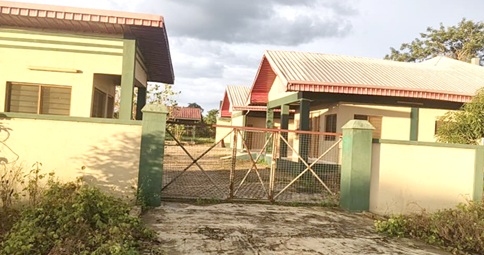
Hope was high when the Kpandai District Assembly was handed over a Cassava Processing Factory under the Rural Enterprise Program (REP), of the Ministry of Trade and Industry's One District, One Factory (1D1F) initiative in December 2022.
However, the factory was never operationalised.
Farmers and processors in the area expected the facility to create jobs, provide a ready market for cassava, improve incomes and reduce the burden of manual processing.
Across communities including Chakori, Balai, Nkanchina, Lonto, Kpadjai, Kabeso, Kitari, Bombari, and Kabonwuli, one of the district's major gari-producing hubs, women continue to process cassava much as they have for decades, manually.
Under the scorching sun, they stand over clay ovens fuelled by firewood, stirring cassava for hours as thick smoke fills the air.
Livelihood
For many households, gari processing is the main livelihood, paying bills and serving as a source of daily sustenance.
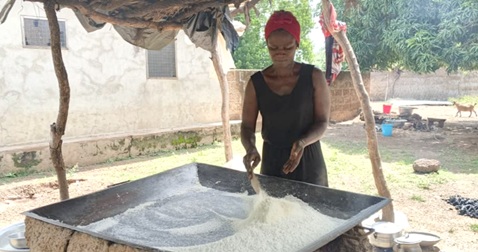
Biyinke Elizabeth is frying gari under smoke and heat at Chakori
Many women had hoped the factory would ease the physical demands of their work and create better market opportunities.
Instead, they continue to rely on labour-intensive methods, while the facility built to support them remains unused.
Hard work, low returns
Producing gari requires significant investment of time, labour and money.
Cassava must be cultivated, harvested, peeled, washed, grated, fermented and roast-fried before it is packaged for sale.
Throughout the process, women endure long hours around smoking ovens and intense heat.
Several processors said years of working under such conditions had taken a toll on their health.
"We were happy when we heard about the factory because we thought it would make our work easier and improve our incomes.
But today, nothing has changed.
We are still suffering from the smoke and the heat," said Biyinke Elizabeth, a processor at Chakori.
Yet, after all the effort involved in producing gari, many women face an even greater challenge selling it.
Buyers no longer coming
Processors said market demand had declined sharply, while production costs continue to rise.
Transportation, labour, milling services and farm inputs have all become more expensive, squeezing already thin profit margins.
Juliana Kastah, a mother of five and gari processor at Balai, said the situation had become increasingly difficult for women who depend on the trade.
According to her, a bag of gari that sold for between GH₵600 and GH₵800 in 2024 now sells for about GH₵300.
Ms Kastah said many women invested heavily in cassava production and processing but struggle to recover their costs. More than 50 bags of her gari, she said, remained unsold at Gbintiri in the North East Region.
"The low prices and lack of buyers have virtually locked down my business," she added.
Other processors shared similar experiences. Some transport gari to markets only to return home with the same stock after failing to secure buyers.
Others accept low prices as little as GH₵15 per bowl as compared to GH₵40 in 2025 simply to recover part of their investment.
"The work is hard, but finding buyers is even harder.
Sometimes, our gari stays for weeks before somebody comes to buy it.
When buyers eventually come, they offer very low prices," another processor said, pushing many processors into debt.
Calls for intervention
The Assemblymember for the Balai Electoral Area, Bilam Solomon, said the factory must not be allowed to go waste.
The women appealed to governmental agencies, development partners and private investors for support and to the Buffer Stock Company to purchase locally produced gari for government feeding programmes.
DCE explains delay
The District Chief Executive for Kpandai, Haruna Abdul-Karim, attributed the delay in operationalising the factory to inadequate power infrastructure, unstable electricity supply and the absence of installation of essential equipment.
According to him, the facility was connected to the electricity supply of the Kpandai Senior High School rather than having a dedicated power source, making it difficult to begin operations.
Mr Abdul-Karim said the assembly had engaged the Volta River Authority (VRA) and other stakeholders to resolve the power challenge.
He explained that arrangements had been completed for the installation of a dedicated transformer, while efforts were also underway to secure machinery and other requirements needed to make the facility operational.
Waiting for change
Despite the challenges, hope is not lost.
Back at Balai, Ms Clara still keeps bags of gari in her room hoping for buyers.
Like many women across Kpandai's cassava-producing communities, she continues to work, hoping that the factory they celebrated four years ago will finally open its doors and provide the market opportunities they were promised.
