
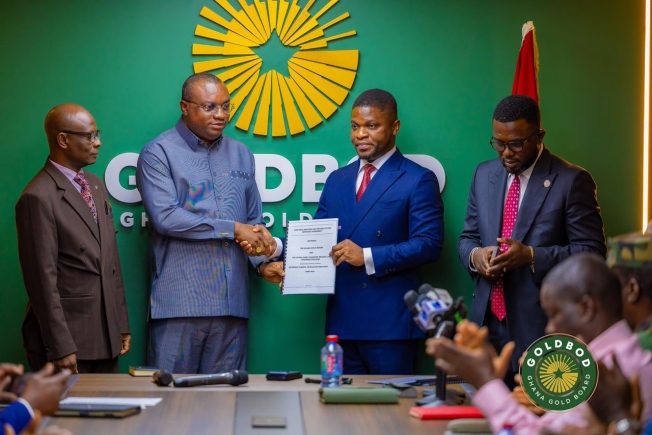
The Ghana Gold Board (GoldBod) has signed an agreement with the Ghana Armed Forces and the Forestry Commission to reclaim 50 hectares of the degraded Tano Nimiri Forest Reserve.
The project, which will cost GH¢27.9 million, aims to restore areas degraded by illegal mining activities.
The joint reclamation project, which will be fully funded by the GoldBod, will be executed by the Ghana Army’s Engineering Regiment and the Forestry Commission.
It comes in response to environmental devastation caused by illegal mining operations, commonly called galamsey.
The Tano Nimiri Forest Reserve experienced severe invasion by illegal miners, resulting in the devastation of more than 200 hectares.
The GoldBod and the Forestry Commission are set to commence a phased land reclamation and restoration process heavily supported by the military.
It forms part of the implementation of the respective nationwide Land Reclamation and Rehabilitation, as well as Land Rehabilitation and Reforestation Services agreements.
Agreements
Under the agreement, the Ghana Armed Forces’ Engineers Regiment will undertake the civil engineering component of the project, including pit filling, grading, land reshaping, compaction and site stabilisation works on 50 hectares of degraded land within Compartment 161 of the forest reserve.
The works are expected to commence on July 6 this year.
The reclamation exercise will involve extensive civil engineering activities, including soil stabilisation, re-greening and other restoration measures aimed at returning the damaged land to a stable and productive condition.
Speaking at a signing ceremony in Accra yesterday, the Chief Executive Officer of the GoldBod, Sammy Gyamfi, described the initiative as the first major environmental restoration project to be undertaken by the institution under its National Reclamation and Environmental Restoration Programme.
He attributed the devastation to years of illegal mining activities that predated the establishment of the GoldBod, stressing that the environmental damage was extensive and had significantly altered the reserve’s natural ecosystem.
He said GoldBod’s focus was not on assigning blame but on restoring the damaged landscape and protecting the country's environmental heritage.
“For us, it is not about who destroyed it. It is about what we need to do to preserve what remains and save the ecosystem,” Mr Gyamfi added.
The GoldBod CEO explained that while the planned intervention would not restore the entire affected area immediately, it represented a significant first step in a broader environmental restoration effort.
“Many people have used reclamation contracts as a cover for illegal mining activities. We wanted a partner that embodied discipline, integrity and patriotism, and we found no better institution than the Ghana Armed Forces,” he said.
He expressed confidence that the Ghana Armed Forces would ensure that the project achieved its intended environmental objectives.
Mr Gyamfi disclosed that the GoldBod would pay GH¢27.9 million to the Engineers Regiment for the earthworks component, while the Forestry Commission would oversee the afforestation and revegetation phase at an estimated cost of GH¢7.2 million over a 10-year period.
He said about GH¢2.2 million was expected to be spent during the first phase of the afforestation programme.
Standards
The Deputy Minister of Defence, Ernest Brogya Genfi, assured GoldBod and the public that military personnel involved in the reclamation exercise would adhere strictly to established standards and regulations throughout the implementation process.
He expressed confidence in the ability of the Ghana Armed Forces to execute the project successfully, citing the military's reputation for discipline, professionalism and accountability.
“The men and women of the Ghana Armed Forces are fully aware of their standards and regulations. Any wrongdoing will be punished, and they are guided by these principles in the execution of their duties,” he said.
The Deputy Minister emphasised that the reclamation project would serve as a pilot initiative whose success could pave the way for similar interventions across the country.
He said the fight against illegal mining must focus equally on prevention and restoration.
The Chief Executive Officer of the Forestry Commission, Dr Hugh C.A. Brown, lauded the GoldBod for being the first institution to respond positively to the commission’s appeal for support in reclaiming degraded forest reserves.
He said the Forestry Commission would be responsible for the afforestation and ecological restoration aspects of the project.
Dr Brown explained that the Forestry Commission, as custodian of the country's forest reserves, would not only supervise the overall project but also lead the long-term restoration of vegetation cover within the affected area.
He revealed that a survey conducted up to the end of 2024 identified nearly 8,700 hectares of forest reserves degraded by illegal mining activities, equivalent to more than 10,000 football fields.
He added that assessments of destruction recorded in 2025 were ongoing and would likely increase the figure.
The Forestry Commission CEO expressed confidence that the collaboration between GoldBod, the military and other state institutions would provide a sustainable model to restore degraded landscapes across the country.
