
Recently, Ghana suffered a major outage of power and water, which brought disruption to towns and cities across the country.
In June, unusually high rainfall and devastating floods caused death and destruction in Accra.
In an ever-changing world due to climate change, we all need to do our bit to make ourselves more self-sufficient and, in the process, alleviate the stress on the planet.
Living out in the ‘bush’, we are not connected to the national electricity grid, and no piped water, so the recent outage did not affect us at all.
We use a solar installation to power lights, fan, fridge, phone, water pump, etc.
We don’t use air conditioning and rely on just the cooling breeze of trees in the garden, which is remarkably effective on a hot March day.
We harvest rainwater from the roof of the house into gutters, then into water barrels situated at convenient points around the building, or into a large underground storage tank.
Every household could copy this if only to have back-up power and water when the main systems are suddenly switched off.
A simple water barrel under a gutter can store enough rainwater for several days.
A cheap solar power system can charge your lights and your phone.
There are solar rechargeable standing fans on the market too, which will also power your phone and rechargeable lights.
The floods in Accra were caused by illegal building on waterways and also drains that were so heavily choked with rubbish (mainly plastic bottles) that the torrents of water which fell that night couldn’t flow.
The government needs to take action against those people who built on waterways and also those public officials who allowed the illegal buildings, but we can each take more responsibility for the safe and secure disposal of our rubbish.
Disposal
Is it so difficult to take that water sachet or plastic bottle home with you for disposal once you have used it?
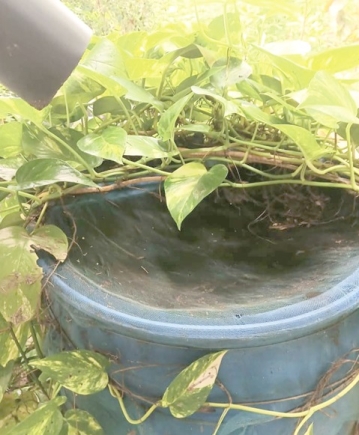
Compost heap
Is it so difficult to shop without acquiring a dozen plastic bags?
I refuse black plastic bags and polystyrene containers whilst shopping at the market.
Everything goes into one cloth carrier bag which I take with me and any cooked food bought goes into a recyclable and washable sealed container.
We have a simple system at our house whereby the rubbish we do accumulate is dealt with.
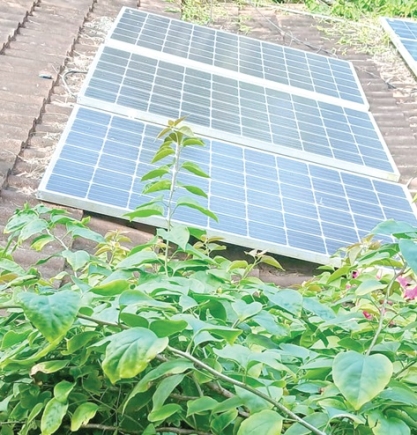
Solar panels on the roof
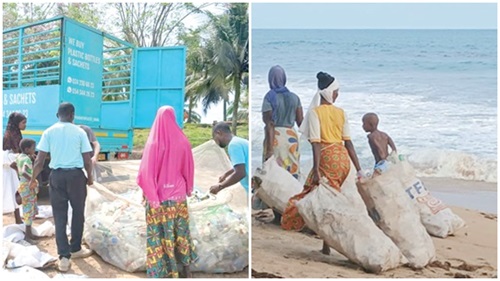
All our plastic bottles and water sachets are saved.
Every couple of months, an NGO in
Elmina, ‘Buy Food with Plastic’, comes to collect them for recycling.
The children even collect the plastic bottles from the beach and receive GH¢1 per kilo.
We also save our empty tins and again, every couple of months the recycling boys from Niger come to collect.
They also take any broken large plastic and metal items (buckets, bowls, chairs, etc.)
Why don’t you find out about what recycling options are available in your area?
All our food waste (egg shells, fruit and vegetable peelings, etc.) is kept in a bucket and each week added to the compost pile along with cut grass and dry leaves.
Over time, it decomposes to make the perfect compost to nurture plants in the garden or in tubs.
None of these activities takes more than a few minutes each week ‒ a sack for the plastic and two buckets, one for compostable waste and one for tins.
After we have done all this, we have very little rubbish leftover but, as there is no refuse collection in the bush, we have resorted to burning it.
This is not an ideal arrangement given the state of the planet, but until there is a public incinerator which can burn refuse to produce power, we have little choice.
Pleas
So my plea to all of you is to do what you can in whatever small way is possible to make Ghana a better and cleaner place.
We cannot rely on the government to do everything.
Yes, there should be regular cleaning done in marketplaces
Yes, there should be more bins for disposing of rubbish in public places, but let us all be more self-sufficient in dealing with our rubbish and the planet's natural resources of sunshine and water.
In so doing, we will make our own lives easier and not end up screaming and shouting the next time (and there will undoubtedly be a next time) that the heavens open to shower us with more water than we can manage or the electricity gets turned off or the water fails to flow.
The writer is an artist.
