
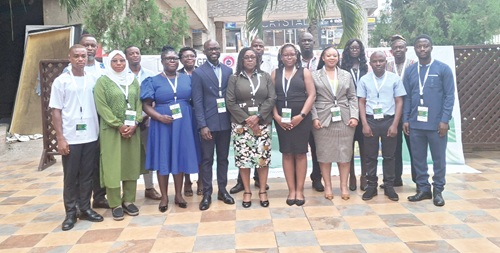
Research scientists at the Council for Scientific and Industrial Research-Water Research Institute (CSIR-WRI) have called for stronger collaboration among relevant institutions for the proper management and protection of the country's wetlands.
The scientists said, given the critical role wetlands play in regulating water flows, supporting biodiversity, storing carbon, and enhancing resilience to climate variability and change, it was important for coordinated policy measures to be implemented to safeguard them.
A Chief Research Scientist and Strategic Operations and Programme Lead at the CSIR-WRI, Dr Ruby Asmah, stressed that the challenges facing wetlands were too complex for any one institution to address alone.
"Researchers have the scientific knowledge; government institutions provide policy direction; conservation organisations bring practical experience; local communities have valuable knowledge of their ecosystems; and development partners provide important support.
"When we bring these strengths together, we have a much better chance of turning information into action," she stressed.
Dr Asmah was speaking at the inception meeting of the Biodiversity Information Optimisation for Resilient Wetland Conservation in Africa (BIOFOWARD) Project.
Context
Wetlands remain among the world's most valuable ecosystems as they regulate water flow, support biodiversity, provide food and livelihoods, store carbon, and enhance resilience to climate variability and change.
Healthy wetlands regulate hydrological processes, reduce flood risks, recharge groundwater, improve water quality, and provide natural buffers against climate extremes.
Yet these ecosystems continue to experience increasing pressure from land-use change, pollution, invasive species, unsustainable resource use, and climate change. Equally concerning is that the biodiversity information needed to guide effective conservation is often fragmented, inaccessible or unavailable.
The BIOFOWARD project directly seeks to address those challenges by helping to improve the availability, quality, accessibility, and use of biodiversity information to support resilient wetland conservation.
The project places strong emphasis on capacity development and partnership to protect wetlands. It thrives on collaboration among research institutions, government agencies, conservation organisations, local communities, and international partners to safeguard wetlands.
Commitment
Dr Asmah said the institute remained committed to research and innovation in support of sustainable water and environmental resource management.
She said the BIOFOWARD project came at "a very important time," given that wetlands were under increasing pressure from pollution, changing land use, unsustainable resource use and climate change.
"Wetlands are extremely valuable, and they support biodiversity, provide livelihoods, contribute to food security, help regulate water systems and play an important role in climate regulation," she said.
The research scientist observed that responding effectively to those challenges required good information.
"We need to know what species we have, where they occur, how they are changing, and what threats they face. Unfortunately, much of the biodiversity information that already exists across Africa is scattered among different institutions, researchers, databases, reports and collections," she said.
She said it was for that reason that the BIOFOWARD project was crucial.
Dr Ruby said that, through the support of the Global Biodiversity Information Facility (GBIF) Biodiversity Information for Development Programme, the project would help in mobilising and digitising priority biodiversity information, improving its quality, promoting the use of recognised data standards, and making this information more accessible through the GBIF network.
Wetlands management
The incoming Director of CSIR-WRI, Dr Emmanuel Obuobie, explained that through biodiversity data mobilisation, digitisation, standardisation, publication through the GBIF network, institutional capacity strengthening, and stronger stakeholder collaboration, the project would create a solid evidence base for conservation planning and policy development.
"This initiative represents more than a data management project. It is an investment in knowledge infrastructure,” he said.
He added that reliable biodiversity information would help governments to make informed policy choices, researchers to generate new knowledge, communities to participate meaningfully in conservation, and development partners to invest with confidence.
Dr Obuobie added that high-quality data was the foundation upon which resilient ecosystems and resilient societies were built.
He said conserving biodiversity was not only an environmental responsibility but also an essential climate adaptation strategy.
