
The government has announced plans to make sanitation a key measure for assessing the performance of metropolitan, municipal and district chief executives (MMDCEs).
The directive, which forms part of comprehensive efforts to help end perennial flooding and its impact, includes the return of sanitation functions to metropolitan, municipal and district assemblies (MMDAs) to strengthen local accountability and improve waste management.
Under the new directives, the assemblies are required to demonstrate measurable improvements in cleanliness and waste management in their respective jurisdictions across the country.
They are also expected to strengthen accountability in local governance and improve environmental health and sanitation, with the government seeking to restore the operational responsibility of MMDAs.
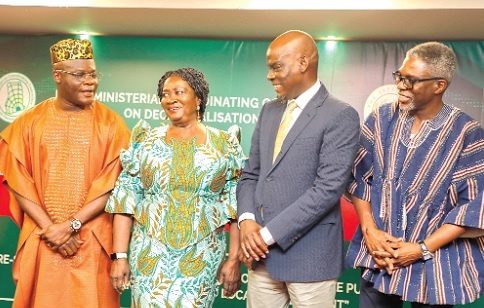
Opening the national dialogue on decentralisation and responsive governance in Accra yesterday, the Vice-President, Professor Naana Jane Opoku-Agyemang, said the directive formed part of broader efforts to make cleanliness a daily responsibility rather than an occasional exercise.
“As part of the Clean Up Ghana campaign, we are intensifying monthly cleanup exercises. However, this cannot remain a monthly event. Cleanliness must become a daily discipline.
“To reinforce this commitment, sanitation performance is now a key performance indicator for metropolitan, municipal and district chief executives,” she said.
Background
The 2026 edition of the dialogue, organised by the Inter-Ministerial Coordinating Committee on Decentralisation (IMCC), seeks to reset local governance and improve public service delivery.
On the theme, “Re-setting Democratic Decentralisation for Accountable Public Service Delivery and Accelerated Local Development,” the dialogue provides an opportunity to assess what has worked, what has not, and what needs to change.
It brought together key stakeholders, including ministers, Members of Parliament, district chief executives, heads of institutions, development partners, traditional and religious leaders, civil society organisations and academia, to reflect on the country’s decentralisation journey and chart the way forward.
Sober reminder
The Vice-President stated that the recent flooding in several major cities was a reminder of the consequences of weaknesses in waste management, sanitation practises and the enforcement of environmental standards.
She said the threat underscored the need for stronger local leadership, greater accountability, and sustained citizen participation.
“The government is, therefore, prioritising environmental health and sanitation in local governments,” Prof. Opoku-Agyemang said.
She added that the proposed district environment, health and sanitation department under the National Decentralisation Policy and Strategic Framework would restore operational responsibility for environmental health and sanitation to MMDAs.
Prof. Opoku-Agyemang stated that the government had developed the National Decentralisation Policy and Strategic Framework 2026–2030 as a roadmap for the next phase of decentralisation reforms, with a focus on deepening decentralisation, strengthening local governance institutions and improving public service delivery.
Sanitation financing
The Minister of Local Government, Chieftaincy and Religious Affairs, Ahmed Ibrahim, said sanitation was not merely about waste collection but a fundamental determinant of public health, environmental sustainability and productivity.
He said monitoring visits by the ministry to assemblies in the Greater Accra Region had revealed gaps in sanitation infrastructure, financial management and project execution, underscoring the need to strengthen the capacity of MMDAs to deliver effective sanitation services.
Mr Ibrahim said inadequate financing remained a major constraint to sanitation delivery at the local level, stating that the resources available to assemblies were insufficient to meet the growing demand for sanitation infrastructure and services.
Consequently, the ministry had issued the 2026–2028 Fiscal Guidelines for MMDAs to establish uniform and transparent standards for mobilising and managing internally generated funds, while additional central government financing and public-private partnerships would be needed to bridge the funding gap, he said.
Ghana’s decentralisation leadership
An academic and politician, Prof. Kwamena Ahwoi, who chaired the dialogue, stated that the event marked the 37th anniversary of the country’s decentralisation journey and provided an opportunity to reflect on the progress made and the challenges that remained.
He said Ghana had become a reference point for decentralisation on the African continent, with several countries making study visits to understand and learn from the programme.
He added that the dialogue also offered the country an opportunity to take the lead in the localisation and implementation of the African Charter on the Values and Principles of Decentralisation, Local Governance and Local Development.
NDPS implementation
The Executive Secretary of the Inter-Ministerial Coordinating Committee on Decentralisation (IMCC), Dr Gameli Kewuribe Hoedoafia, said the implementation of the National Decentralisation Policy and Strategic Framework must focus on effective coordination and tangible results at the local level.
He stressed that the framework should not become another policy document left on shelves, but must translate into concrete actions that would improve local governance and development.
