
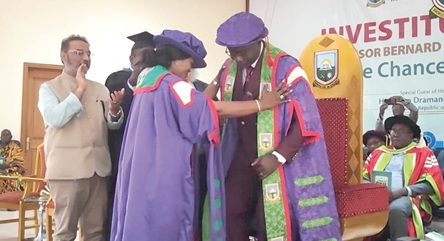
The new Vice-Chancellor of the University of Mines and Technology (UMaT), Prof. Benard Kumi Boateng, has said it is time to transform the university into a leading technology university in Africa.
UMaT, he said, had the potential to become Africa's premier technology university, supporting industry and the country with the technical human resources needed.
Speaking during his investiture ceremony, Prof. Kumi-Boateng said the transformative vision was borne out of an honest assessment of the university's strengths, weaknesses and challenges.
The move, he said, would be driven by strategic planning, innovation, accountability and collective effort rather than by disruption.
He announced a five-pillar transformation agenda focusing on financial sustainability, excellence in teaching and research, stakeholder and student engagement, human capital development and governance and performance management.
On financial sustainability, the vice-chancellor said UMaT must reduce its dependence on government subventions, indicating that the university experienced an average funding shortfall of about 25 per cent between 2021 and 2025.
Academic values
Prof. Kumi-Boateng said there were plans to establish a dedicated commercialisation unit to convert research, consultancy services and university assets into sustainable revenue streams.
The university, he said, would be managed with sound business discipline while preserving its core academic values, adding that the strategy aligned with the country’s industrialisation agenda by ensuring that UMaT's expertise in mining, minerals and engineering directly contributed to national development.
He also pledged aggressive investment in infrastructure to address inadequate laboratories, overcrowded lecture halls and accommodation shortages that continued to affect academic activities.
Prof. Kumi-Boateng said the university would continue to develop its campuses at Essikado and other satellite campuses, while strengthening partnerships with industry to support cutting-edge research and innovation.
"We must have facilities that match our ambitions if we are to build the MIT of Africa," he said.
Excellence
Prof. Kumi-Boateng emphasised that academic excellence must be accompanied by professionalism, discipline, integrity and mutual respect.
"The university is not only a place where knowledge is acquired; it is also where character is built and leadership is nurtured," he stated.
He said his administration would review the university's student conduct framework to promote responsibility, inclusiveness and professionalism, while protecting the dignity and individuality of every student.
He reiterated that UMaT remained a secular institution under Statute 51 and would not tolerate occult practices or activities that could undermine peace and discipline on campus.
Accommodation
On students’ welfare, Prof. Kumi-Boateng announced several social intervention programmes, including the expansion of affordable and secure hostel accommodation under a "bed for every bright mind" initiative.
The vice-chancellor said there would be the establishment of an emergency student support fund for students facing financial hardship, bereavement or medical emergencies, and the introduction of a work-study programme that would offer part-time jobs in libraries, laboratories and other university departments.
He further pledged to strengthen counselling and mental health services, introduce transport support initiatives to reduce commuting costs, and explore food security interventions, including subsidised meals for financially disadvantaged students.
The vice-chancellor expressed concern that women currently accounted for only about 24 per cent of UMaT's student population.
Prof. Kumi-Boateng said there would be targeted scholarships, mentorship programmes and inclusive learning policies to increase female enrolment and empower more women to pursue careers in science, technology, engineering and mathematics.
He also set a target of increasing postgraduate enrolment to 25 per cent of the undergraduate population while expanding international collaborations to improve UMaT's global rankings and international visibility.
Prof. Kumi-Boateng promised accelerated promotions, structured annual capacity-building programmes, postgraduate sponsorships, ICT and professional training, improved health support, housing and mortgage schemes with financial institutions, wellness programmes and a formal mentorship system to ensure experienced staff transferred knowledge to younger colleagues before retirement.
Performance management
To strengthen accountability, he said there were plans to introduce a comprehensive performance management framework, including value-for-money audits, contract monitoring and regular performance evaluations.
"What gets measured gets delivered," he said, adding that the system would ensure transparency and accountability to students, staff, government, alumni and industry partners.
