
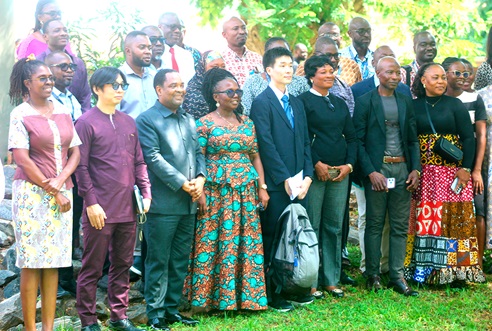
Biomedical scientists and laboratory technicians from six African countries are undergoing a four-week hands-on training in modern laboratory technology that will enhance their skills in combating infectious diseases.
Organised by the Noguchi Memorial Institute for Medical Research (NMIMR) and the University of Ghana, in collaboration with the Japan International Cooperation Agency (JICA), the training, which is coming on the heels of the recent outbreak of Ebola in some parts of Africa, is designed to equip the eight biomedical scientists and laboratory technicians with advanced diagnostics and surveillance skills for emerging infectious diseases.
It will also help them to become more knowledgeable and proficient in infectious disease diagnosis and acquaint them with advanced laboratory management skills.
It will also improve the capacity of the participating countries, namely Ghana, Liberia, Nigeria, Sierra Leone, Togo and Zambia, to improve their facilities in the areas of diagnosis, treatment and prevention.
The Director of the NMIMR, Professor Dorothy Yeboah-Manu, opened the training, dubbed the Third Country Training Programme on enhancing laboratory skills for infectious diseases in African countries, a regional capacity-building programme, in Accra last Monday.
Present were the Provost of the College of Health Sciences, Professor Alfred Edwin Yawson; representatives from JICA and the Japanese Embassy in Ghana and some members of the diplomatic corps of the participating countries.
Training
Professor Yeboah-Manu said the training programme became necessary following the West African Ebola crisis in 2018/2019, during which one of the issues that arose concerned a lack of laboratory capacity.
She said that over the past years, through productive collaboration with JICA, the institute had trained close to 100 scientists across the West African sub-region, with a few participants from the Central African regions.
She said the eight, who formed the smallest cohort of trainees, had already completed four weeks of virtual training and during this four-week hands-on training, they would receive instruction from the three departments of the institute involved in infectious diseases, namely bacteriology, virology, and parasitology.
Professor Yawson commended the institute for its commitment to dedicating its effort, skill and expertise towards strengthening the capacities of scientists and laboratory professionals across the region, adding that, if it continued with such collaboration and knowledge sharing, the sub-region and continent would be better positioned and adequately equipped to respond effectively to any global health challenges that may arise as it was currently facing.
“The recent resurgence of the Ebola crisis makes this training especially timely and most opportune, as it reinforces the need to continually strengthen the expertise and preparedness of our laboratory personnel in responding to such outbreaks and safeguarding our populations,” he said.
Public health emergencies
The Chief Representative of JICA, Uchiyama Takayuki, said recent public health emergencies such as the Ebola virus outbreak in the Democratic Republic of Congo and the Hantavirus had underscored the critical importance of resilient public health systems, particularly those supported by strong surveillance and biomedical research capabilities.
“Now more than ever, it is essential to strengthen the capacities of laboratory workforces across sub-Saharan Africa, reinforce biomedical research networks and improve responses to public health emergencies,” he said.
The First Secretary of the Japanese Embassy in Ghana, Takama Teratani, commended the institute and JICA for their continued efforts in organising the training programme, adding that the institute stood as a symbol of the friendship between Ghana and Japan and reflected their common commitment to improving public health and advancing scientific research.
