
An international tax consulting firm, KPMG, has expressed confidence that the country is on course to achieve its 2026 macroeconomic targets, given the positive economic trends and the government's ongoing policy interventions.
The firm explained that flagship initiatives such as the Big Push Infrastructure Programme, the 24-Hour Economy, the Accelerated Export Development Programme, the Oil Palm Development Programme and investments in energy, transport and industry were expected to drive job creation, boost productivity and diversify the economy.
However, KPMG cautioned that global economic uncertainty, geopolitical tensions, commodity price volatility and future domestic debt maturities remained significant risks that could undermine the country's recovery.
It, therefore, urged the government to sustain fiscal discipline, strengthen external reserves through the Ghana Accelerated National Reserve Accumulation Policy and continue structural reforms to safeguard recent economic gains and build resilience against external shocks.
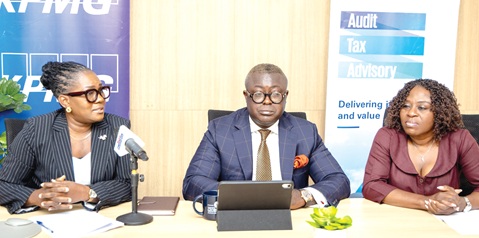
Addressing a press conference on the 2026 Mid-Year Budget Review in Accra yesterday, the Partner and Head of Advisory at KPMG, Kwame Sarpong Barnieh, said current economic trends suggested that the government's macroeconomic objectives for the year were within reach.
He, however, stressed that sustaining the recovery would require prudent fiscal management and the consistent implementation of structural reforms to protect the economy from external shocks.
"The remainder of the year remains positive.
There are trends that are suggesting that the government's macroeconomic targets are achievable. "Nevertheless, Ghana continues to face risks from global economic uncertainties, geopolitical tensions, commodity price volatility and future domestic debt maturities," he said.
Growth priorities
Mr Barnieh said the immediate priority was to institutionalise the recent macroeconomic gains by maintaining low inflation, exchange rate stability and stronger external buffers.
He explained that Ghana's next phase of economic development should focus on translating macroeconomic stability into higher productivity, quality jobs and improved household incomes.
He added that the successful implementation of programmes such as the 24-Hour Economy and the Big Push Infrastructure Programme would be critical to achieving those objectives.
Private sector investment
Calling for greater mobilisation of private capital, Mr Barnieh stated that the country's development ambitions could not be financed by the public sector alone.
He said the improved macroeconomic environment presented an opportunity to rebuild investor confidence and attract both domestic and foreign private investment into productive sectors.
He stressed that achieving this would require a predictable policy environment, transparent procurement processes, efficient public-private partnerships and stronger governance to ensure investors had confidence in the viability of government-backed projects.
Tax reforms
For her part, the Partner on Tax at KPMG, Justina Amartey-Kwei, who endorsed the government's tax reform agenda in the mid-year budget, stated that the revenue measures were important for broadening the tax base, improving compliance and sealing revenue leakages.
She stressed that reforms such as the new VAT regime, Fiscal Electronic Devices, digital VAT compliance measures and AI-powered customs systems would enhance tax administration and create a level playing field for businesses.
