
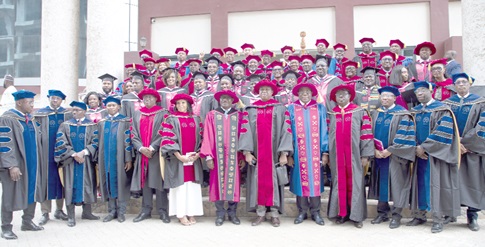
The Commission on Human Rights and Administrative Justice (CHRAJ) has called for institutional integrity, accountability and inclusion as essential pillars of sustainable leadership.
It said competence without integrity posed a risk to institutions, stressing that accountability strengthened ambition rather than weakened it.
The Commissioner of CHRAJ, Dr Joseph Whittal, made the call while delivering the keynote address at the 2026 graduation ceremony of Nobel International Business (NiBS) University in Accra.
The ceremony was on the theme: "Excellence Beyond Borders: Preparing Leaders for a Changing World."
Drawing on his experience at CHRAJ, Dr Whittal said many institutional failures were caused not by a lack of competence but by ethical compromise.
"Competence without integrity is a liability, not an asset," he stated.
Graduands
The University graduated 28 students from its Doctor of Business Administration (DBA), Doctor of Business Leadership (DBL), Doctor of Philosophy (PhD), Master of Financial Management (MFM) and Executive Master of Business Administration (EMBA) programmes.
Dr Whittal encouraged leaders to embrace transparency, welcome scrutiny and build inclusive institutions, saying organisations that broadened participation across gender, geography and generations performed better.
He encouraged the graduates to uphold ethical standards as they assumed leadership positions, reminding them that they were going to work in a rapidly changing world shaped by artificial intelligence, climate change and shifting global dynamics, where trust in institutions had become increasingly valuable.
The CHRAJ Commissioner also urged them to combine technical knowledge with sound judgement and strong character, saying: "Go beyond the borders that others will try to place around your ambition."
Beyond academic excellence
The Chancellor of NiBS University, Dr George Nana Agyekum Donkor, said excellence should go beyond academic achievement to include innovation, resilience, ethical leadership and lifelong learning.
He announced plans to launch the Alumni Club 100 and a Research and Infrastructure Fund to mobilise resources for research, infrastructure development and the University's long-term growth.
The President of the Ghana FinTech and Payments Association, Martin Kwame Awagah, said higher education institutions must continuously adapt to the demands of the digital economy.
He said technologies such as artificial intelligence, data science and digital finance were reshaping industries, and therefore urged graduates to embrace lifelong learning, innovation and ethical use of technology.
