
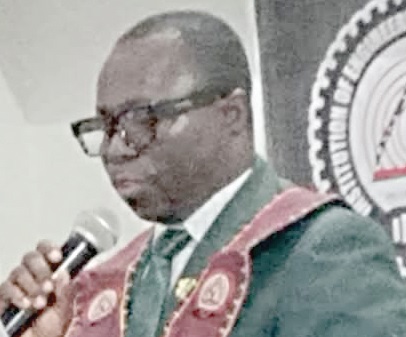
The Institution of Engineering and Technology, Ghana (IET-GH) last Friday inducted 130 engineers into the institution with a call for the country to plan seriously for an underground urban rail transportation system, beginning with the most congested metropolitan corridors.
The President of IET-GH, Wonder Salami Davor, who made the call, said, “This is not a call for another conventional transport project. It is a call for us to think beyond today's limitations and begin designing the transportation system that Ghana will need in the next 30, 50 and 100 years”.
An underground rail network, he said, integrated with existing road and surface transportation systems, could significantly reduce congestion, improve mobility, lower emissions and reclaim valuable urban land currently consumed by road expansion.
Vision
“But such a vision will require more than engineering drawings and construction contracts. It will require innovation in financing, integrity in procurement, excellence in design, rigorous safety standards, local capacity development and long-term political commitment.
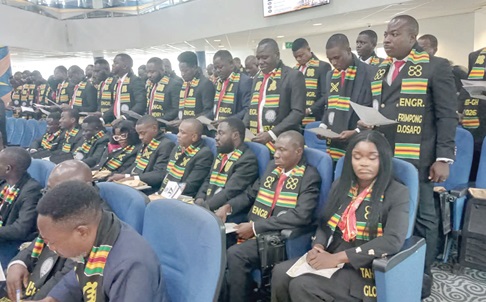
And this is where you, our newly inducted engineers, come in,” Mr Davor said at the 17th induction ceremony.
The event was on the theme: "Engineering Ghana's Future: Innovation, Integrity and Sustainable Development".
Responsibility
Mr Davor said the event was more than an induction ceremony and that it was the beginning of a responsibility — “a responsibility to use your knowledge, skills and creativity to solve Ghana’s most pressing challenges and to build a better future for generations yet unborn”.
The theme of the ceremony, he said, captured precisely what the profession must stand for.
“Ghana does not merely need more engineers
Ghana needs engineers who will dare to think differently, design boldly, act ethically and deliver solutions that stand the test of time.
“Our cities are growing rapidly, but our transportation infrastructure is struggling to keep pace.
Traffic congestion, long commuting times, excessive fuel consumption, pollution and the loss of productive hours continue to impose a high economic and social cost on our nation,” he said.
As engineers, Mr Davor said they must not simply manage the problem, they must engineer a solution for the future.
He told the engineers that they were entering the profession at a critical moment in the country's development.
“You have the opportunity to become the generation that transforms our cities, modernises our infrastructure, advances local manufacturing, embraces sustainable construction and develops technologies suited to our own environment,” he said.
He cautioned that engineering without integrity could become a danger to society, adding, “Your calculations may be technically correct, but if your professional judgment is compromised by corruption, shortcuts or personal interest, the consequences can be catastrophic.”
The Adabraka Mantse, Nii Tetteh Agyabeng II, who chaired the function, charged the inductees to take note that “engineering moved the world and so what we do affects the world”.
He also encouraged them to go out and deliver.
