
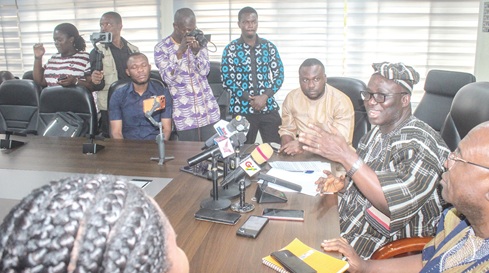
The government has set a target for 2028 to make the country fully self-sufficient in rice production, with a total paddy production of 3.31 million tonnes.
The Minister of Food and Agriculture, Eric Opoku, announced this at a press conference in Accra yesterday, on a Regional West African Resilient Rice Value Chains (REWARD) project.
"We have a gap of 44 per cent to fill, and our goal, our determination, is to fill this gap by the end of 2028," he said.
Mr Opoku said rice was now the country’s second most important cereal after maize, and that population growth, urbanisation and changing consumer preferences had pushed demand well ahead of what local farmers could produce.
He said milled rice production had risen from about 650,000 tonnes in 2024 to 960,000 tonnes in 2025, yet local production met only about 56 per cent of national demand, with 44 per cent still imported at a cost of about $500 million annually.
"That is money that could be earned by Ghanaian farmers, millers, and traders," the minister said.
Project
The minister said the REWARD project was an $18.8 million grant from the African Development Bank (AfDB), designed to remove bottlenecks holding back the rice value chain.
He described the project as a "Feed Ghana in action for rice", in line with the Feed Ghana programme launched by President John Dramani Mahama in Techiman, on April 12, last year.
Mr Opoku said under the project, the government would support policy and regulatory reforms, develop 3,200 hectares of land for rice production in the northern savannah ecological zone, equip selected seed centres with seed cleaners, provide quality seed and mechanisation to raise yields from 3.5 to 4.5 tonnes per hectare, and also supply machinery, including rotary tillers, seed drills, combined harvesters, rice transplanters and boom sprayers.
Ten strategically located rice processing centres would be identified and equipped with parboiling vessels and hermetic storage cocoons to reduce post-harvest losses and link farmers to markets and the private sector.
"The project will reach more than 20,000 smallholder farmers in the Tamale metropolis, Mion, Savelugu, East Mamprusi, West Gonja, Bawku West, Wa Municipal, Sissala East and Nandom," Mr Opoku added.
The project is expected to be launched in the first week of November this year, and would be implemented in the 2027 production season.
Mr Opoku further announced a shift in import policy, saying import quotas would be linked to local investment, with importers required to show verifiable partnerships with local producers before import permits were granted.
"We are not banning imports, which will only hurt consumers. Instead, we are channelling the value of imports into local production and empowering our farmers," he said.
The minister expressed appreciation to Japan for a $2.5 million grant to supply equipment, which would include eight combined harvesters, trucks, 11 seed cleaning machines, maintenance tools and transformers.
They are expected to arrive in the country in November this year. There will also be training for value chain actors.
