
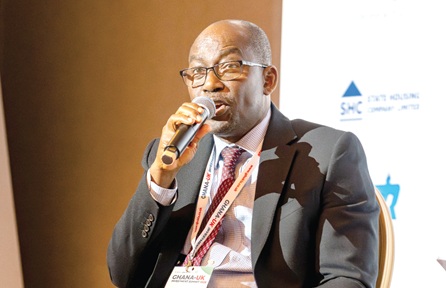
Ghana is targeting a major wave of international capital by backing over 20 new oil and gas exploration fields with sweeping policy reforms, the Acting Chief Executive Officer (CEO) of the Ghana National Petroleum Corporation (GNPC), Kwame Ntow Amoah, has said.
Speaking at the Energy Investment Opportunities Panel at the just-ended Ghana-UK Investment Summit in London, the GNPC CEO said the country was tackling regulatory delays and fiscal volatility head-on to build deep execution certainty for global investors.
He pointed out that Ghana's current investment momentum was rooted in oil or gas fields that were already actively producing.
“A massive $2 billion injection is currently funding new well developments across the productive Jubilee and TEN fields, alongside, a $1.5 billion investment which is being deployed into the landmark Sankofa–Gye Nyame project, engineered to scale domestic natural gas production up from 270 million to 350 million standard cubic feet per day (mmscf/day),” he told the delegates.
Value added exploration
Mr Ntow-Amoah said the financial commitment proved that global operators saw exceptional value in extending field lifecycles while maximising existing assets.
He also suggested a resilient institutional trust in Ghana’s underlying resource baselines.
He invited international investors to explore Ghana's vast waters, particularly the expansive Accra-Keta Basin, where the government is offering more than 15 new ocean locations for drilling, ranging from easily accessible shallow waters to ultra-deep-sea zones.
The Tano Basin, the CEO also added, also presented deepwater open blocks (drilling sites) as well as other opportunities for new investors that might wish to team up with existing license holders.
He added that the Saltpond Basin also featured six available oil and gas fields, opening the door for international companies to partner with the GNPC to provide technical and operational support.
Onshore exploration
On onshore exploration, Mr Amoah highlighted the Voltaian Basin as the country's most significant frontier opportunity, boasting multiple confirmed natural surface oil seeps.
He stated that GNPC and its exploration subsidiary, GNPC Exploration and Production Limited Company (Explorco), were actively looking for strategic partners to help unlock this onshore wealth.
Additionally, Mr Amoah revealed that GNPC was pushing forward with its “Hub Strategy”.
That, he said, was a targeted campaign to partner with international firms to harvest more than one billion barrels of oil and 1.3 trillion cubic feet of natural gas that were currently trapped in smaller, isolated offshore fields that had proven difficult to develop on their own.
Acknowledging the critical need for speed to market, Mr Amoah revealed that the Ministry of Energy and Green Transition was proactively streamlining the laws and approval processes that governed oil and gas investments so as to avoid delays.
Chief among the practical reforms, he pointed out, was the creation of a “one-stop-shop” system for permits, which would give investors a single, fast-track approval process with a strict deadline."
Risk sharing
Responding to questions on how the country handles investment risks which could often scare investors away, the CEO said the country was adjusting its financial terms to ensure a fairer balance of risks and rewards.
Mr Amoah explained that while the standard corporate income tax remained at 35 per cent, and the state maintained its automatic 10 per cent minimum share in all oil projects, a new flexible tax system was being introduced.
“This upcoming "sliding scale" royalty system means the government's tax cut will adjust dynamically based on production levels and oil prices, ensuring the terms remain fair even when market conditions change,” he assured the gathering.
Mr Amoah maintained that would optimise current baseline royalty rates, which ranged from four per cent to 10 per cent for crude oil and sat at a steady five per cent for natural gas.
