

Agriculture engineering experts have called for the development and enforcement of clear standards for locally fabricated agricultural and food-processing machinery to improve safety, quality, durability and confidence in the country’s growing agro-machinery industry.
They said although Ghana had demonstrated strong local capacity to fabricate machines for agriculture and food processing, the absence of consistently applied standards for materials, performance, safety and hygiene could undermine the gains made by local manufacturers.
Speaking to an article by his team of experts, the Head of the Department of Agricultural Engineering, School of Sustainable Engineering, College of Agriculture and Natural Sciences, University of Cape Coast, Prof. Francis Kumi, said the nation could do better.
The article titled “From Fabrication to Certification: Why Ghana Must Standardise Agro-Machinery,” they noted that locally produced grinding mills, fufu-processing machines, decorticators, multi-crop threshers and other equipment needed to be manufactured to meet clear and measurable standards.
The experts included the Head of the Agricultural Engineering and Transport Division of the CSIR-Crops Research Institute, Fumesua, Kumasi, Dr Shadrack Kwadwo Amponsah.
They stressed that a machine’s ability to function should not be the only measure of its quality, particularly when the equipment comes into direct contact with food.
Inappropriate materials
According to them, the use of inappropriate materials on food-contact surfaces could result in corrosion, deterioration of coatings and possible contamination, while rough welds, cracks and poorly finished or inaccessible areas could trap food residues and make proper cleaning difficult.
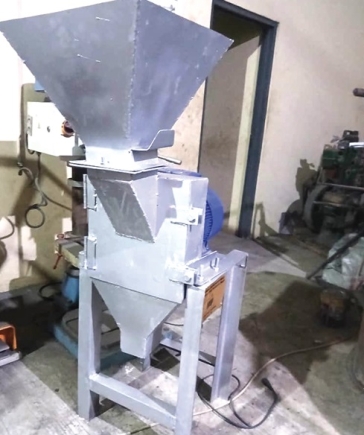
A locally made agro-processing machine
They also identified operator safety as a major concern, pointing to exposed belts, pulleys, chains, rotating shafts and cutting components that could cause serious injuries.
The experts said standardisation should not mean that all fabricators produced identical machines, but rather that they complied with agreed minimum requirements for quality, safety, hygiene, materials, performance and testing.
They cited the “fufu pounding machine” as an example of the need for clearer classification, explaining that some machines marketed under that name actually grind, mix or knead cooked cassava and plantain rather than pound them.
The experts said standardisation should not require all fabricators to produce identical machines, but rather ensure that they complied with agreed minimum requirements for quality, safety, hygiene, materials, performance and testing.
They called for stronger collaboration among the Ghana Standards Authority, Food and Drugs Authority, Ministry of Food and Agriculture, universities, research institutions, professional engineering bodies and local fabricators to develop and enforce practical standards for commonly used agro-machinery.
They said Ghana could also draw lessons from international frameworks, including standards developed by the American Society of Agricultural and Biological Engineers and ISO/TC 23, while adapting them to local crops, operating conditions, fabrication capacity and user needs.
The experts further proposed an engineering-based process involving design and analysis, workshop inspection, laboratory testing where necessary, field performance evaluation, certification and structured market feedback.
They argued that such a system would move the industry away from a largely “fabricate and sell” culture towards one where manufacturers' performance claims could be independently verified.
Agricultural engineers, they said, had a critical role to play in supporting fabricators with design calculations, computer-aided drawings, material selection, welding procedures and quality control, as well as training operators in safe use, calibration and maintenance.
They also urged the government to link public procurement and subsidy programmes to certified performance and appropriate local-content requirements to ensure that publicly funded machinery met minimum standards for safety, durability and performance.
In the medium term, they proposed the establishment of a National Centre for Agro-Machinery Research, Testing and Certification to provide independent testing infrastructure, support standards development, validate performance claims and strengthen the local manufacturing sector.
They said the ultimate objective should be to protect farmers and processors while helping Ghanaian fabricators to build machines that could be trusted locally and compete confidently beyond Ghana's borders.
