
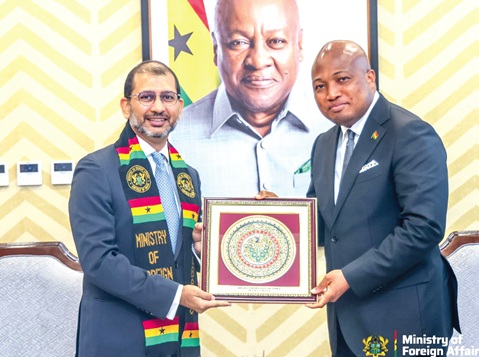
Ghana and India have set an ambitious target to double current bilateral trade volumes to $6 billion dollars in the medium term, the Minister of Foreign Affairs, Samuel Okudzeto Ablakwa, has said.
Speaking while receiving the letters of credence from the new Indian High Commissioner to Ghana, Surinder Bhagat, in Accra last Friday, Mr Ablakwa said the target was “very doable” given the strong trade cooperation between the two countries.
“We have set for ourselves very ambitious targets.
We want to double our trade volumes beyond the $3 billion margin that we are doing currently. In the medium term we are looking at about $6 billion, which is very doable,” he stated.
The minister identified agriculture, information and communication technology (ICT), including Artificial Intelligence and the pharmaceutical sector, as three priority areas for deepening bilateral relations.
On agriculture, Mr Ablakwa said India’s comparative advantage in agri-equipment and machinery would be critical to supporting President John Dramani Mahama’s “Feed Ghana Initiative”.
“We also want to work closely in the area of agriculture because you have a comparative advantage there.
You have agri-equipment and machinery that we will need.
The President wants us to collaborate with you strongly to support his Feed Ghana initiative,” he said.
In the ICT space, he said that the government had just overhauled the basic education curriculum to make AI and robotics compulsory, and was rolling out a One Million Coders flagship programme.
“The President also has one of his flagship programmes, the One Million Coders Programme.
So, we want to work with India, which is a powerhouse.
Everybody knows when it comes to IT, when it comes to AI, the Internet of Things, India is a powerhouse,” he added.
Health
On pharmaceuticals, the minister said Ghana was keen to build domestic manufacturing capacity in line with the President’s health sovereignty agenda.
He recalled Africa’s experience during COVID-19, where the continent with 25 per cent of the global disease burden produced only one per cent of vaccines.
“We learned the hard way during COVID. We had to be in the queue forever, even though we had the ability to pay for the vaccines.
But we just could not have access and we had to rely on the benevolence of India.
We are always grateful to you. If India didn't come to our aid, we don't know what would have happened,” Mr Ablakwa said.
He expressed optimism that cooperation in the three strategic areas would create jobs for Ghana’s youth and anchor the country’s economy on a path of development in Africa.
