
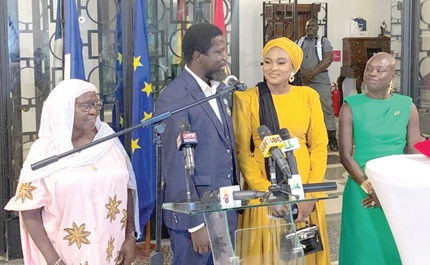
The French Embassy in Ghana has conferred the insignia of “Chevalier de l’Ordre des Arts et des Lettres” (Knight of the Order of Arts and Letters), one of France’s top cultural honours on renowned Ghanaian artist, Ibrahim Mahama.
The “Ordre des Arts et des Lettres” recognises persons who have distinguished themselves through artistic or literary creation or might have contributed to the influence of arts and literature in France and the world at large.
The Ambassador of France to Ghana, Diarra Dimé-Labille, presented the award given by the French Ministry of Culture in the presence of Mahama’s family, friends and leading figures in Ghana’s arts and culture community at the ambassador’s residence in Accra.
The ceremony comes days before Mahama mounts “The Harvest Season (Le Temps des récoltes),” his first major Paris exhibition at the “Fondation Cartier pour l’art contemporain,” running from October 22, 2026 to February 28, 2027.
Conceived in resonance with his Tamale institutions, the show would feature nine artists and collectives selected by Mahama, including Dorothy Akpene Amenuke, Gideon Appah, James Barnor, Zohra Opoku and Postbox Ghana.
Commendation
The French ambassador praised Mr Mahama for transforming international recognition into collective opportunity for Ghanaian artists.
She said the artist had never turned away from Tamale despite his global success.
“Through the Savannah Centre for Contemporary Art, Red Clay and Nkrumah Volini, you have built an extraordinary artistic and intellectual ecosystem in northern Ghana where younger generations can learn, where archives can be preserved and where communities can meet,” the ambassador said.
Ms Dimé-Labille described Mr Mahama’s generosity as central to his practice, noting how he consistently brought other artists along.
She cited French Embassy’s Création Africa programme at Red Clay, where two projects discovered there were now receiving top-level support.
Ms Dimé-Labille said the honour was to celebrate Mr Mahama’s exceptional international career and artistic practice deeply rooted in Ghana’s history and transformation.
His works, according to Ms Dimé-Labille reactivates materials and infrastructure from Ghana’s industrial, colonial and postcolonial past, explores memory, labour, circulation and transmission.
She also lauded the commitment of the artist to younger generations through the Savannah Centre for Contemporary Art (SCCA), Red Clay and Nkrumah Volini in Tamale, spaces dedicated to production, research, archives and education.
Support
Mr Mahama called for greater state support for the visual arts, saying the sector lagged behind music and other creative disciplines due to lack of investment.
He said many talented Ghanaian artists struggled for recognition at home despite making impact globally.
“Visual arts is a bit lagging behind in terms of support. It’s very difficult economically to push without state support.
We’re doing so much to promote Ghana; if we can do it on our own here, then with state resources, a lot more can be done,” he said.
Mr Mahama urged artists to work hard, be patient and use their circumstances to tell their stories, while aiming for the global stage.
He expressed appreciation to his parents for supporting his choice to study art.
