
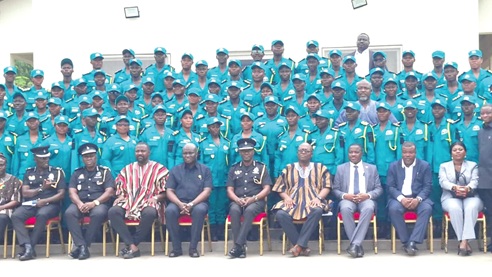
Government has charged the first batch of Feed Ghana Brigadiers to lead the drive for food security, job creation and agribusiness growth in every district.
The Minister of Food and Agriculture, Eric Opoku, said the two-week training of the brigadiers at the Police Training School was not to teach basic agriculture, but to build discipline, teamwork, resilience and a sense of duty.
The 506 brigadiers were made up of qualified professionals holding first degrees and master’s degrees in agriculture and related disciplines.
The training aimed to prepare the brigadiers for field service under pressure and to instil punctuality, accountability, and also prepare them physically and mentally for their mission in their respective districts of deployment.
The District Feed Ghana Brigadiers would serve as the link between national policy and district implementation.
Their duties include coordinating activities, mobilising stakeholders, supporting data collection, monitoring progress and ensuring accountability.
Beyond government work, the brigadiers would also provide agricultural advisory and technical support to private agribusinesses, households, schools, public institutions and faith-based organisations.
As Master Gardeners, they would also promote household food production, nutrition and environmental stewardship.
They were also presented with a motorbike each to help in the mobility and discharge of their duties.
Mr Opoku said the Feed Ghana Brigade initiative is to birth a disciplined workforce to “reset Ghana’s agriculture for food security, job creation, industrialisation and national prosperity”.
He stressed that agriculture itself demanded discipline, hence the need for the training.
“A farmer cannot plant at the wrong time and expect the right harvest.
A coordinator cannot submit false reports and expect successful implementation.
That is why discipline is not only for the parade ground.
Discipline is for the farm. Discipline is for public service. Discipline is for national development,” he said.
Mr Opoku congratulated the brigadiers and added that they were leaving as “ambassadors of production, discipline, hard work and national renewal.”
Prospect
The minister revealed that even before the passing-out, companies had begun requesting their services, with one firm requesting 20 brigadiers and another requesting two.
He assured agricultural graduates that this was only the first phase, and that more brigadiers would be recruited and trained to meet growing demand.
The minister cautioned that the brigadiers must work under District Directors of Agriculture and collaborate with existing Extension Agents.
“The success of this programme will not be measured by speeches in Accra. It will be measured by the number of farmers reached, the number of acres cultivated, the quantity of food produced and the confidence restored in Ghana’s agriculture,” he said.
He charged the brigadiers to “serve with humility, discipline, honesty, patriotism and urgency”, adding that “we are not waiting for the future.
We are building it now”.
For his part, the National Feed Ghana Coordinator, Bright Edward Kodzo Demordzi, said the brigadiers were ready to support the country’s agricultural extension system.
He affirmed that their training, which combined technical agriculture knowledge with leadership, discipline, ethics, teamwork, communication and physical fitness, has prepared them effectively for the task ahead.
“They have demonstrated the discipline, competence and commitment required to complement and strengthen Ghana’s agriculture extension systems,” he stated.
He urged the brigadiers to uphold professionalism, integrity and humility, and to collaborate with regional and district directors of agriculture and extension officers.
Professionalism
The Inspector General of Police, Christian Tetteh Yohuno, in a statement delivered on his behalf by the Director in Charge of Human Resource, Commissioner of Police (COP) Frederick
Kofi Blagodzi, charged the brigadiers to uphold professionalism, integrity and discipline as they begin national service.
He said the two-week training was designed to instil higher standards of conduct.
“Carry something from the academy, from the highest training ground of the Ghana Police Service, to your homes and wherever you find yourself,” he said.
