
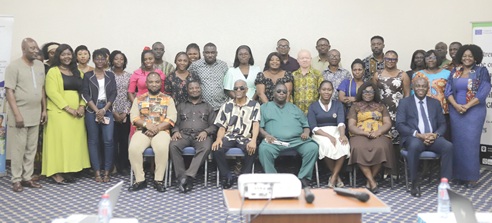
The Executive Director of the Ghana Federation of Disability Organisations (GFD), Mr Peter Anomah Kordie, has called on journalists to use their platforms to amplify the concerns of persons with disabilities and influence policymakers to address issues affecting them.
He said the media had the power to shape public opinion and hold policymakers accountable, making journalists important partners in promoting the rights and inclusion of persons with disabilities.
Mr Kordie made the call at a media capacity workshop organised by the GFD in partnership with the Mental Health Society of Ghana and Africa Disability Institute, with support from the European Union (EU) and in collaboration with the Ghana Journalists Association (GJA).
The workshop was on the theme: “Effective Media Reporting on Disability: Promoting Economic Justice and Inclusion Through Responsible Journalism.”
It brought together journalists, editors, social media and online media practitioners, as well as persons with disabilities.
The workshop aimed to equip journalists with knowledge and skills to report on disability issues accurately, ethically and inclusively.
Participants were taken through disability awareness, ethical interviewing and storytelling, the legal framework on disability and appropriate disability terminology.
Media partnership
Mr Kordie said effective media coverage was important to ensure that issues affecting persons with disabilities received attention from policymakers and the public.
He explained that without adequate media coverage, the concerns of persons with disabilities could fail to receive the attention needed from policymakers and the wider public.
Mr Kordie called for a strong and continuous partnership between the GFD and the media to keep disability issues visible in the national conversation.
“This partnership should not be a one-time engagement. It must be a continuous process,” he said.
He said the GFD would continue to train and work with journalists to improve their understanding of disability issues and strengthen reporting on matters affecting persons with disabilities.
Mr Kordie identified education, health and employment as key areas of the federation’s advocacy agenda and urged journalists to pay attention to emerging issues affecting persons with disabilities.
Rights-based approach
The Senior Disability Inclusion Advisor, Ms Rebecca Nunoo, took participants through disability rights and inclusion and introduced them to the rights-based approach to disability.
She said the approach recognised persons with disabilities as people with rights that must be upheld, while legal frameworks provided the basis for protecting those rights.
Ms Nunoo explained disability as the interaction between impairment and barriers that prevented a person from participating on an equal basis with others.
She said removing such barriers was important to achieving inclusion and urged journalists to help the public understand the barriers faced by persons with disabilities.
Ms Nunoo also stressed the need for journalists to use appropriate and inclusive language when reporting on persons with disabilities to avoid reinforcing stereotypes and misconceptions.
Legal framework
The Disability Inclusion Advisor, Mr Bismark Amoh, took participants through legislative frameworks and international conventions that protect the rights of persons with disabilities.
He cited the United Nations Convention on the Rights of Persons with Disabilities (UNCRPD), which Ghana ratified in 2012, as one of the key international instruments protecting their rights.
Mr Amoh said Article 8 of the Convention required the media to promote respect for the rights and dignity of persons with disabilities in their portrayal.
He said persons with disabilities should not be presented as helpless people who were only dependent on support.
He also referred to Article 21, which addresses access to information and the right of persons with disabilities to seek, receive and impart information.
He urged the media to make information accessible to persons with different forms of disabilities.
He explained that reports that relied only on audio, video or visual content without captions, sign language interpretation or other accessible formats could leave some persons with disabilities without access to information.
Mr Amoh encouraged journalists to consider captions, sign language interpretation and accessible digital content when producing stories.
Proper representation
For his part, the National President of the Ghana Federation of Disability Organisations, Joseph Atsu Homadzi, urged journalists to consider whose voices and images were represented in the media when reporting on disability issues.
He said journalists could help give visibility to the concerns of persons with disabilities by ensuring that their stories, voices and experiences were properly represented.
Mr Homadzi said the media had an important role to play in ensuring that persons with disabilities were not left out of public and national discussions.
