
Investors from the United Arab Emirates (UAE), France, the United Kingdom (UK), and Austria have, in the past six months, expressed strong interest in investing in Electrochem Ghana Ltd (EGL).
As part of efforts to acquire a stake in one of West Africa’s largest salt mining companies through its planned $500 million expansion programme, the investors have visited the project site to assess its viability and better understand its operations.
The funds would be used to complete engineering works, automate infrastructure, construct pumps, pipelines and a jetty at Ada West.
It would also be used to procure vessels and barges, build a salt refinery and caustic soda plant, acquire mining equipment, and establish a research-focused university.
Production capacity
When completed, the project is expected to increase the company's annual salt production capacity from about one million tonnes to five million tonnes a year.
This came to light when a delegation from Civil Society Organisations (CSOs) visited the EGL at Ada Songhor in the Greater Accra Region last Wednesday.
The delegations held discussions with the management of EGL and the Ada Traditional Council on the challenges, opportunities and growth potential of Ghana’s salt industry, while also assessing the progress of the Ada Songhor Salt Project five years after the commencement of investment, development and production.
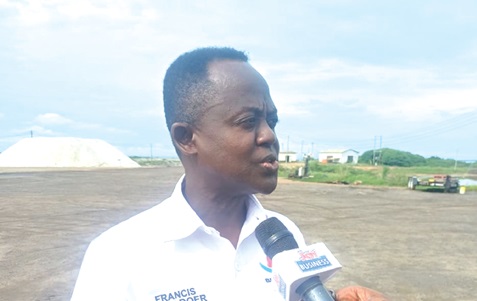
The Chief Executive Officer (CEO) of the EGL, Francis Buamah, said the company had engaged many potential investors over the past six months as part of efforts to secure funding for the ambitious expansion.
He said that interest had come from investors in the UAE, France, the UK and Austria, who he said, viewed Ghana's salt industry as a strategic entry point into the wider African market.
Mr Buamah, therefore, expressed confidence that the company could attract the required capital, citing the growing demand for salt and its numerous industrial applications across the continent.
“We’ve had investors from the United Arab Emirates, France, the United Kingdom and Austria who are interested in the salt business and see Ghana as a gateway to the African market.
"Being part of what we are doing at Electrochem gives investors access to more than 1.2 billion people across Africa, and that makes the project very attractive,” he said.
Funding prospects
Mr Buamah said the company had been conducting extensive due diligence with prospective investors, to ensure that any partnership aligned with its long-term vision also safeguarded Ghanaian interests.
He pointed out that while Electrochem sought foreign capital, it remained committed to maintaining majority Ghanaian ownership and retaining the economic benefits of the business within the country.
Deeper understanding
A Policy Lead at Africa Centre for Energy Policy (ACEP), Kodzo Yawtse, who was a member of the delegation, stated that Ghana urgently needed a comprehensive policy framework for the salt sector to guide its development, address potential disputes over concessions and boundaries, and create a clear vision for maximising the resource's economic value.
Mr Yawtse said that while the government could provide an enabling environment for investment, the responsibility for securing capital largely rested with the company.
