
The Executive Director of the Fisheries Commission, Prof Benjamin Betey Campion, has stated that only community-led approach can reverse the rapid decline of the country's marine resources and protect the livelihoods of thousands of artisanal fishers.
He has therefore commended the Canoe and Fishing Gear Owners Association of Ghana (CaFGOAG), and Mundus Maris for the Small Scale Fisheries Academy initiative which places fishing communities at the heart of fisheries management towards rebuilding the nation’s fisheries .
He said empowering fishers to identify challenges, develop solutions and actively participate in decision-making would strengthen compliance with fisheries laws and accelerate the recovery of the country's depleted fish stocks.
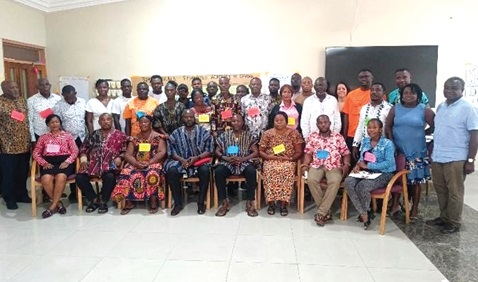
Prof. Campion said this at the inaugural Small-Scale Fisheries Academy (SSF Academy) training organised through a partnership between Mundus Maris and the Canoe and CaFGOAG, building on earlier initiative by Blue Ventures Conservation.
The Academy forms part of a year long activities in the partnership between Mundus Maris and CaFGOAG aimed at strengthening community-led fisheries governance and supporting national efforts to restore Ghana's declining marine fisheries.
The week-long training, held in Winneba in the Central Region, equipped regional and national facilitators from Ghana's four coastal regions with facilitation and dialogue skills to lead fisheries co-management initiatives in respective regions and fishing communities.
Prof. Campion described facilitation as an essential leadership skill, saying fisheries management was no longer about imposing decisions but enabling fishing communities to collectively identify and address the problems confronting the sector.
"The Fisheries Commission cannot solve every challenge alone. When our officers and community leaders are equipped with facilitation skills, they can engage fishers, fish processors, traders and canoe owners to develop practical solutions that they own and are willing to implement," he said.
He said the Commission was implementing wide range reforms under the new Fisheries and Aquaculture Act, 2025 (Act 1146) to rebuild fish stocks while protecting the livelihoods of small-scale fishers who contributed about 70 per cent of Ghana's locally landed fish.
Reforms
The reforms, he explained, include compulsory registration of fishers and canoes, installation of vessel tracking devices, strict enforcement against Illegal, Unreported and Unregulated (IUU) fishing, establishment of marine protected areas and a subsidy regime that rewards only fishers who comply with fisheries regulations.
"Our objective is not simply to punish offenders but to restore the fisheries. Fish are renewable resources. If we protect them today, we can witness significant recovery within our lifetime and improve the incomes of fishing communities," he stated.
The Partnership Manager of Blue Ventures Ghana, Nana Kweigyah, said the academy was designed to transform fisheries governance by creating inclusive local co-management structures where chief fishermen, canoe owners, fish processors, traders and other fishworkers meet regularly to discuss local challenges and implement practical solutions.
He said the initiative would also help fishing communities to share among members, the principles and the understanding of the new Fisheries and Aquaculture Act 2025 while strengthening co-management structures from the grassroots.
Women's Cordinator of CaFGOAG, Central Region and a fish processor, Jennifer Apoh Sam, said she would used the knowledge gained to facilitate regular community dialogue sessions to educate fishers on the new fisheries law and encourage collective problem-solving through participatory discussions and visual learning tools.
