
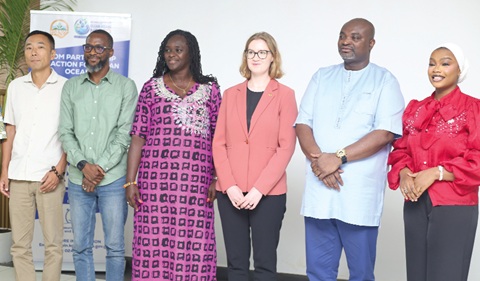
The Chief Executive Officer (CEO) of the Environmental Protection Authority (EPA), Professor Nana Ama Browne Klutse, has called for enhanced institutional collaboration, policy coherence, and concerted national effort to tackle the 1.1 million tonnes of plastic waste confronting the country.
She said given the devastation plastic inundation had on the environment, it was important for bold, decisive and sustained policy interventions, backed by collective responsibility, to deal with the pressing environmental challenge.
Speaking on "The State of Plastic Pollution and Policy Response in Ghana" at the policy dialogue on plastic pollution in the country in Accra last Friday, she stressed that strengthening policy coherence and multi-stakeholder action was the best approach for cleaner oceans and effective plastic management.
The Policy Dialogue on Plastic Pollution was organised by the EPA in partnership with the Embassy of Germany under its Environmental Diplomacy Project.
Plastic menace
Statistics by the EPA show that Ghana produces about 1.1 million tonnes of plastics annually, out of which barely 10 per cent is recycled, leaving a whopping 90 per cent ending up in gutters and the ocean.
Prof. Klutse described plastic pollution as "one of Ghana’s pressing environmental and development challenges" and stressed that the time had come to work collectively to address the challenge.
She noted that while plastics provided important benefits to households, businesses and the wider economy, their unsustainable production, consumption and disposal were placing increasing pressure on the environment and communities.
"The impacts are visible in our drainage systems, waterways, beaches and coastal areas, with consequences for flooding, biodiversity, livelihoods and public health," she said.
Interventions
The EPA boss said although the country had made progress through policies, strategies and regulatory measures aimed at addressing these challenges, the complex nature of the menace required more than policies.
"The more important question is whether these policies are sufficiently coordinated, adequately resourced and effectively implemented to deliver measurable results. We must, therefore, strengthen the link between policy and implementation," she stressed.
Prof. Klutse said while it was critical for government institutions to work together more effectively, local authorities needed the capacity and resources to manage waste and enforce relevant measures.
Again, she said the private sector must be supported and encouraged to invest in sustainable production, recycling and circular economy solutions.
"Producers must take greater responsibility for the products and packaging they introduce into the market," she said.
Prof. Klutse also underscored the need for academia and research institutions to provide the evidence, data and innovation needed to guide policy on plastic waste management.
She also urged civil society and communities to play crucial roles in driving behavioural change, "while the media can strengthen public awareness and accountability".
Prof. Klutse stressed that plastic pollution was not the responsibility of one institution or one sector, but that it was a shared national responsibility.
National partnership
She said it was in recognition of the collaborative nature of the fight against plastic pollution that the National Partnership for Clean Oceans (NPFCO) had been established.
She explained that NPFCO was an initiative that provided an opportunity to create a structured national platform through which the government, private sector, academia, civil society, development partners, communities and other stakeholders could work together towards cleaner watercourses, coastlines and oceans.
Timely initiative
The Head of the Projects and Resource Mobilisation Unit of EPA, Hussein Kassim, said the diverse nature of participants in the dialogue underscored the important reality that plastic pollution was not a challenge that any one institution could solve alone.
He added that although the country had made significant efforts to address plastic pollution through policies, regulations, programmes and partnerships, the persistence of plastic waste in communities, drains, watercourses and coastal environments was a reminder that more work must be done to strengthen the connection between policy, implementation, financing and collective action.
