
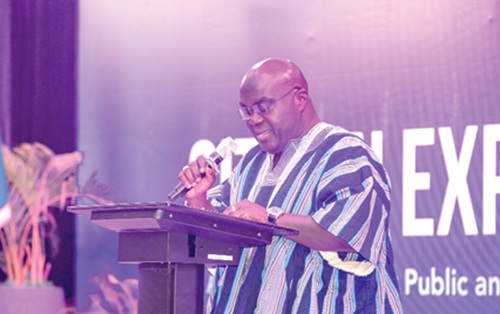
A book that diagnoses the challenges facing the public and civil service, and seeks to offer practical solutions to them has been launched in Accra.
Titled: "Citizen Experience: A Reset for Superior Public and Civil Service Delivery", the book was co-authored by the Chief of Staff, Julius K. Debrah, and marketing professor, Robert E. Hinson.
It proposes seven measurable dimensions against which public institutions should assess themselves, namely accessibility, clarity, speed, dignity, fairness, consistency and outcome.
The authors argue that the repeated experiences of citizens, not institutions' self-perception, represent the true face of Ghana's public service.
The book goes beyond diagnosing the challenges facing public and civil service delivery to offer practical options for reform, calling for government strategy to be designed around citizens; the citizen "journey" through institutions to be restructured; investment in frontline officers; and success to be measured by people's actual experiences rather than internal metrics such as budgets and timelines.
The book was launched by Vice-President Prof. Naana Jane Opoku-Agyemang yesterday with the first 10 copies auctioned between GH¢200,000 and GH¢20,000.
Prof. Opoku-Agyemang commended the authors for bringing practical governmental experience into close dialogue with academic scholarship, describing the book as intellectually grounded while remaining focused on the realities of implementation.
She described the book's distinction between how institutions saw themselves and how citizens actually experienced them as its most important contribution, warning that this gap remained a key obstacle to genuine reform.
The Vice-President said while government often measured success through completed projects, budgets and timelines, it rarely interrogated the actual experience of the people those projects were meant to serve.
She warned that as long as government continued to focus on internal performance metrics while citizens judged institutions by their lived experiences, a gap between the two would persist, regardless of how many reform programmes were launched.
The Vice-President urged heads of public and civil service institutions to view their operations through the eyes of the citizen, identifying honestly where services were fair, clear and acceptable, and where they fall short.
She said such honest self-assessment was the first step towards genuine reform.
Prof. Opoku-Agyemang also called for a redesign of frequently used services such as passport applications, business registration and licensing, and urged officials to consider whether processes were built for the convenience of institutions or for the people who used them.
"Every unnecessary delay, every avoidable queue and confusing procedure comes at a cost in time, in dignity, in income, and more importantly, in public trust," she said.
Prof. Opoku-Agyemang further stressed the importance of frontline public servants, describing them as the face and voice of government to ordinary citizens.
She further cautioned that the pursuit of efficiency in public service delivery must never come at the expense of equity, adding that the true measure of citizen-centred service was fairness and respect.
Authors
The Chief of Staff described the book as “the new social contract" in a democracy, adding that the legitimacy of the government was renewed or weakened not only at the ballot box, but in everyday encounters between citizens and the state.
Mr Debrah cautioned against blaming frontline officers for failures that were often rooted in broken systems, unreliable technology, unclear instructions and weak supervision.
He said good people were frequently trapped inside bad systems, and that leadership determined the outcomes institutions produced even where budgets and constraints were similar.
He stressed that in the eyes of the citizen, the frontline officer, the clerk, nurse, teacher or counter staff effectively was the state, making their training, working conditions and dignity central to any reform effort.
Mr Debrah said reforms that improved service for some while leaving behind the elderly, persons with disability, citizens without smartphones or those with limited literacy were not good enough, insisting that such groups must be placed at the centre of design rather than at the margins.
For his part, Prof. Hinson described citizens as the founders and owners of every public institution in the country, and called for a complete reimagining of the relationship between the state and the people it served.
He said achieving real reform in public service delivery required radical honesty and a willingness to change public institutions without political hedging, insisting that accountability must be made non-negotiable rather than optional.
Prof. Hinson said consequences for poor service must be real, while rewards for excellence must be compelling enough to shift institutional behaviour and culture.
He further called for nothing short of a complete reimagining of the relationship between the state and citizens.
