
Farmers along the White Volta in the North East Region are bracing for possible flooding as Burkina Faso’s Bagré Dam approaches the water level at which its spillway gates could be opened next week.
The development has heightened fears among farmers whose crops are yet to mature, with many worried that a rise in downstream water levels could inundate their farms and worsen their already precarious livelihoods.
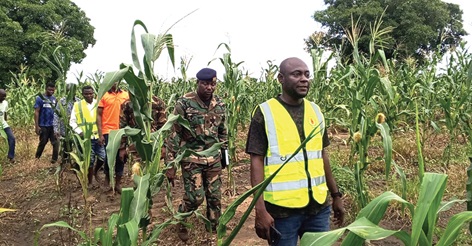
When the Daily Graphic visited communities such as Duu, Kpasenkpe, Janga and Nasia in the West Mamprusi Municipality, it observed that maize crops were at the tasseling and early cob-development stages.
At this stage, the crops are not yet ready for harvesting, meaning that any flooding that inundates the farms could result in significant crop losses, leaving farmers with little or nothing to salvage.
Water levels
As of August 23, 2026, the reservoir of the Bagre Dam stood at 234.43 metres, just 0.32 metres below the 234.75-metre threshold at which SONABEL, operators of the Bagre and Kompienga dams, says it may begin releasing water.
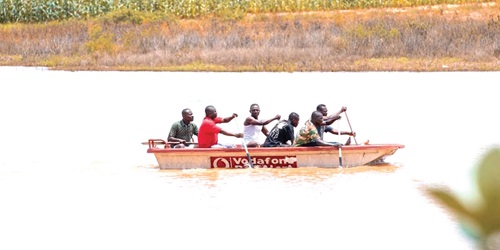
Personnel of NADMO conducting a simulation exercise ahead of the anticipated spillage
The reservoir was 92.38 per cent full and 0.57 metres below its Normal Operating Water Level of 235 metres.
However, the situation at the Kompienga Dam shows a significant rise in the reservoir level.
As of August 23, the upstream water level stood at 178.05 metres, representing a filling rate of 80.71 per cent. According SONABEL, the reservoir level is 1.95 metres below its Normal Operating Water Level of 180.00 metres.
One floodgate at the Kompienga Dam has, however, been opened at 0.50 metres since January 1, 2026, resulting in a discharge of 18.93 cubic metres per second.
The farmers fear that if the spillway gates are opened before they harvest their crops, the resulting rise in water levels could inundate farms and compound the losses suffered during previous floods.
Farmers' concerns
A farmer, Salifu Mugis, said a major flood during the farming season could have serious consequences for his household because his maize crop was not yet ready for harvest.
“I have been having sleepless nights because if the floods come these days, it will be a disaster for me because all my crops are not matured yet” he said.
Asked why he continued to farm along the riverbanks despite being aware of the perennial flooding, he said the land was more fertile and had better moisture conditions, resulting in higher yields compared with farming on higher ground.
Another farmer, Osman Hakim said many farmers were still struggling to recover from previous flooding and would find it difficult to withstand another major loss.
NADMO preparedness
Meanwhile, the National Disaster Management Organisation (NADMO) has initiated an emergency response strategy to mitigate the impact of floods and safeguard affected communities in the wake of the possible spillage of excess water from the dams.
It includes deploying Operation Thunder Bolt and setting up safe havens across all flood-prone areas to accommodate all displaced individuals.
It has also conducted water-level assessments across rivers and streams likely to be affected by the spillage.
The exercise is aimed at monitoring current water levels and identifying potential risks in vulnerable communities.
The Regional Director of NADMO, Alhaji Tahiru Rafiu, said the organisation was adequately prepared to respond to the flood and minimise the potential impact.
“We are well prepared. The negative impact we experience will be drastically reduced. We cannot eliminate it completely because it is both a natural and man-made disaster,” he said.
He indicated that the organisation was also sensitising residents to the anticipated spillage and the precautionary measures to protect lives and property.
Alhaji Rafiu, however, advised communities at the downstream area of the White and Black Volta rivers to relocate to higher grounds for safety in the event of the flood.
Background
For communities along the White Volta, flooding has become an annual occurrence, particularly during the rainy season when heavy rainfall coincides with the release of excess water from the Bagre and Kompienga Dams in Burkina Faso.
As has been the case in previous years, residents living in communities downstream of the White and Black Volta rivers are usually among the worst affected, with flooding often destroying farms, homes and other property.
Farmers who cultivate along the riverbanks are often among the worst affected, with crops sometimes destroyed before they mature for harvesting.
Writer’s email:
