
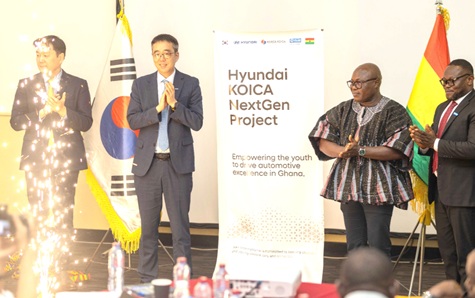
Over 400 people, mostly young people, and 17,000 Technical and Vocational Education and Training (TVET) students and family members are expected to benefit directly and indirectly from a $3.41 million project aimed at strengthening Ghana's TVET system.
It is designed to equip young people with industry-relevant and future-ready automotive skills through improved training infrastructure, institutional capacity, industry partnership and exposure to emerging automotive technologies.
Hyundai-KOICA NextGen
The five-year initiative, Hyundai-KOICA NextGen Project, will also benefit 125 TVET instructors and facilitators directly, support six start-up teams and create industry-linked opportunities for participating students.
Implemented by Plan International Korea and Plan International Ghana, in partnership with Hyundai Motor Company, and supported by the government of Korea through the Korea International Cooperation Agency (KOICA), the project will also establish two automotive service hubs in the Greater Accra and Volta regions, modernise automotive training in advanced mobility and digital technologies, strengthen the capacity of TVET instructors and expand opportunities for internships, employment, mentoring and entrepreneurship.
The project was launched in Accra last Thursday on the theme: "Empowering the youth to drive automotive excellence in Ghana".
It was referred to as the Automotive Service Excellence and Youth Empowerment (ASEYE) project during its development and preparation, and the launch marked the unveiling of its new identity — Hyundai-KOICA NextGen.
The acting Country Director of Plan International Ghana, Frederick Tei-Nobi, said Ghana's young people had the talent, creativity and ambition to contribute significantly to the country's economic transformation. However, what they needed were the right skills, opportunities, practical experience and connections to the world of work, which the project sought to advance.
He pointed out that the automotive industry was changing rapidly with new technologies, including electric mobility, digital diagnostics and advanced automotive systems.
He said the country's training systems must, therefore, evolve alongside the industry, pointing out that the project sought to contribute to a more responsive and industry-relevant
TVET ecosystem —one that equipped young men and women with the technical and employability skills they needed to participate confidently in the automotive sector.
"The project gives us an opportunity to challenge perceptions and create pathways where young women can see themselves as technicians, engineers, entrepreneurs, diagnostic specialists, electric mobility professionals and leaders," he said.
Budget
The Country Director of KOICA, Dong Wan Woo, said KOICA would contribute half of the total project budget, with the other half provided by Hyundai Motor Company, adding that it was expected to end in December 2030.
He said that, in addition to its financial contribution, KOICA would bring its development cooperation experience, partnership with Ghanaian institutions and project oversight to help ensure effective implementation and sustainable results.
The Director General of the Ghana TVET Service, Dr Eric Kofi Adzroe, who launched the project on behalf of the Minister of Education, Haruna Iddrisu, mentioned the progress so far made with regard to the project which started in April 2026 to include a review of the new Electric Vehicle alternative curriculum, which had been targeted to be completed in November 2026, the identification and thorough inspection of the sites for two maintenance and training hubs, and procurement of equipment for the project, made up of two electric vehicles, two general automotive training units and electric vehicle chargers.
He said the ministry remained committed to advancing the national TVET agenda and that the project stood as an admirable example of the kind of industry-responsive training they wished to see across the country.
The Head of Communications, Hyundai Motor Company, Jaesun Yoo, said developing skilled talent and offering access to skills and careers were essential to the industry's long-term growth.
He added that through the project, they hoped to support all participants as they built their practical skills and careers, realised their potential and prepared the next generation to contribute to the automotive sector and to make a meaningful impact on society and the world at large.
Present at the launch were officials from the Ministry of Youth Development and Empowerment, the Commission for TVET, heads of the Applied Technical Institute, Ho Technical University and Plan International Ghana.
