
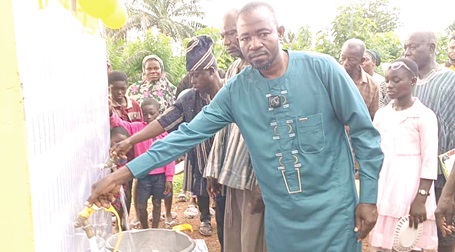
Three rural communities in the Kpandai District of the Northern Region now have improved access to safe drinking water after the district assembly completed mechanised water systems.
The systems, constructed at Lesseni, Kojobone and Kabonwuli, are expected to bring lasting relief to residents who have struggled with water shortages for many years.
The project, undertaken by the Koddeg Construction Ghana Limited, commenced in April and was completed in July this year.
For decades, access to potable water remained a major challenge in the predominantly farming communities.
Women and children often spent several hours each day walking long distances to streams and other unsafe water sources to fetch water for household use, exposing families to health risks and limiting time for education, farming and other productive activities.
That situation is expected to change with the drilling and mechanisation of the three water systems, which will provide a more reliable supply of safe drinking water to the beneficiary communities.
In addition to addressing water scarcity, the intervention is expected to improve sanitation and hygiene, reduce the burden of infection, and enhance residents' overall quality of life.
It also supports the assembly's efforts to attain Sustainable Development Goal (SDG) 6, which seeks to ensure universal access to safe water, sanitation and hygiene.
Improving Living Conditions
Handing over the facilities, the District Chief Executive (DCE) for Kpandai, Haruna Abdul-Karim, described access to potable water as a critical requirement for public health and socio-economic development.
He said the mechanised water systems formed part of the assembly’s broader efforts to improve living conditions and expand access to essential social services across the district.
Mr Abdul-Karim noted that many communities in the district continue to experience water shortages, forcing residents to depend on unprotected water sources and increasing their exposure to waterborne diseases such as diarrhoea and typhoid fever.
“Clean and safe water is critical to the health and well-being of our people. These projects are intended to reduce the challenges associated with water scarcity and support healthier communities,” he said.
The DCE explained that although some communities have boreholes fitted with hand pumps, many can no longer adequately meet growing demand due to population growth, frequent breakdowns and challenges associated with the area's water table.
Sustainability Measures
Mr Abdul-Karim encouraged communities to establish effective water management committees to oversee the operation, maintenance and protection of the systems.
The Managing Director of the Koddeg Ghana Limited, Mohammed Halid, said the systems were designed with modern technology to ensure efficiency and reliability.
According to him, the facilities operate on a hybrid power system that combines solar energy with electricity, ensuring a steady water supply even when one power source becomes unavailable.
Renewed Hope
For residents of Lesseni, Kojobone and Kabonwuli, the new facilities mark a significant milestone in efforts to address years of hardship caused by inadequate access to water.
Some residents recalled spending long hours searching for water and queuing at streams that could no longer meet the needs of the growing population.
