
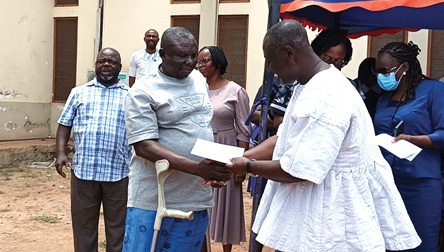
For 60-year-old Israel K. Golomeke, who is visually impaired, getting through an ordinary day can involve expenses that many people take for granted.
Transport fares, basic necessities and the cost of finding a sustainable means of earning a living can quickly become difficult to manage when opportunities are limited.
That is why for Mr Golomeke, support for persons with disabilities (PWDs) must go beyond occasional assistance. What he wants is an opportunity to work, earn an income and meet his daily needs without constantly depending on others.
His story mirrors the hopes of 59 PWDs at Ashaiman who have received nearly GH¢400,000 in financial assistance, equipment and medical support under the Disability Common Fund.
For the beneficiaries, the support represents more than a government intervention. It is a chance to turn their skills and determination into livelihoods and move closer to economic independence.
The Ashaiman Municipal Assembly distributed the assistance at a sensitisation programme on Monday, September 14, 2026, as part of efforts to promote inclusion, transparency and the effective use of the fund.
The Municipal Chief Executive (MCE), Mr Freeman Tsekpo, said GH¢242,900 was allocated for financial support, while equipment valued at GH¢133,405 was distributed.
One beneficiary received medical assistance, 43 received financial support to start or expand businesses, while 15 others received equipment, including deep freezers, industrial sewing machines and laptops to support various income-generating activities.
More than a handout
For the Assembly, the intervention was intended to provide more than temporary relief.
Mr Tsekpo said the ultimate goal was to enable beneficiaries to establish sustainable businesses and improve their livelihoods.
To ensure that public resources were protected, the Assembly had embossed identification numbers on all equipment supplied to beneficiaries.
He explained that the equipment remained the property of the Assembly and would be monitored to ensure that it stayed with the beneficiaries and was used for its intended purpose.
“We have embossed all the equipment we have supplied to them.
This means that the property belongs to the Assembly,” he said.
The National Coordinator for the Regional Directorate of the National Council on Persons with Disabilities, Joshua Addy, said beneficiaries were selected after a rigorous screening and validation process.
Applicants were interviewed, while their homes and businesses were visited to verify their circumstances and requests.
Mr Addy explained that not every person with a disability qualified for the fund. He said PWDs employed in the formal sector, as well as those outside the formal sector earning above the minimum wage, were not eligible.
Mr Addy, himself a person with a disability, stressed the need for beneficiaries to work hard and use the support to improve their livelihoods.
He further urged PWDs to shun begging, which he described as a criminal offence, and take advantage of opportunities for decent work.
According to him, the International Labour Organisation (ILO) had estimated that PWDs could contribute about seven per cent to GDP growth if given opportunities for decent work.
For his part, the Member of Parliament (MP) for Ashaiman, Dr Ernest Henry Norgbey, called for unity among PWDs in the municipality to enable them to derive maximum benefit from government interventions.
He expressed concern over divisions and the formation of splinter groups within the disability community, saying the situation undermined their collective interests.
Dr Norgbey also appealed for the timely release of the Common Fund, saying delays affected the ability of PWDs to receive support when needed.
He said he would collaborate with the Assembly to provide apprenticeship opportunities for some PWDs in areas such as dressmaking and equip them with tools to enable them to establish themselves after training.
For Mr Golomeke, the programme’s success would ultimately be measured by whether the support enabled beneficiaries like him to earn a living, meet their everyday needs and enjoy the dignity that comes with being self-reliant.
Writer's email:
