
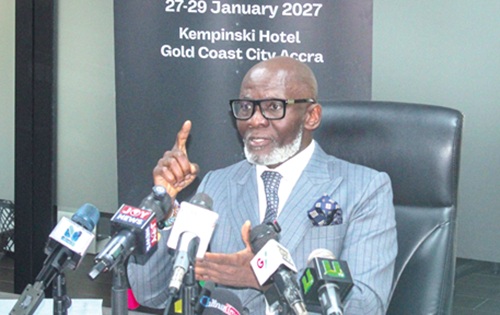
Africa must move beyond signing treaties and declarations to actually implementing free movement and seamless cross-border payments if the continent is to achieve meaningful economic integration, the Founder and Executive Chairman of Africa Prosperity Network (APN), Gabby Asare Otchere-Darko, has said.
He said the failure to implement commitments made under the Abuja Treaty and the African Union (AU) Protocol on Free Movement of Persons was undermining the continent’s ambition of creating a single African market.
Mr Otchere-Darko was speaking at the launch of the 2027 Africa Prosperity Dialogue (APD), scheduled for January 27–29, 2027, on the theme: “The borderless Africa we want: Move free.
Pay seamlessly. Trade more.”
Free movement
He said Africa had spent decades constructing the architecture for integration but had failed to translate many of the agreements into practical benefits for citizens and businesses.
Mr Otchere-Darko cited the Abuja Treaty, signed in 1991 and ratified in 1994, which envisaged a single African market, currency and central bank, as well as a borderless continent by 2028.
He said the AU Free Movement Protocol, adopted in 2018, required ratification by at least 15 member states before it could take effect, but only four countries had so far ratified it.
Mr Otchere-Darko, therefore, urged Ghana and other West African countries to lead efforts to secure the required ratifications, saying Ghana’s expected leadership role in the AU next year presented an opportunity to advance the agenda.
Seamless payments
Mr Otchere-Darko also called for interoperability of mobile money platforms across African borders to make it easier for small and medium-sized enterprises (SMEs) to trade.
He said Africa recorded about $1.4 trillion in mobile money transactions in 2025, out of a global value of about $2.1 trillion.
He argued that allowing Africans to pay across borders using their mobile money wallets would stimulate e-commerce, logistics, transport and investment, while strengthening intra-African trade.
Harmonisation
The Director of Infrastructure, Industrialisation, Trade and Regional Integration at the African Union Development Agency-NEPAD, Amin Idris Adum, said free movement and trade would remain difficult unless African countries harmonised their laws, regulations, standards and systems.
He said the continent’s inability to harmonise transport standards was one reason major projects, including the Abidjan-Lagos Corridor, had struggled to progress.
Mr Adum also said African airlines currently controlled less than 20 per cent of the continent’s air transport market, partly because Africans could not move freely across borders.
For his part, the Co-founder of Borderless Alliance, Ziad Hamoui, said the continent needed to focus on implementation rather than signing more agreements.
He said the organisation, in partnership with APN, would mobilise signatures for the “Make Africa Borderless Now” campaign and present the collective demand to the AU Assembly of Heads of State and Government in February, 2027.
