
The Adolescent Girls’ Programme (AGP) is making a positive impact on girls, with falling teenage pregnancy rates in basic schools in the Central Tongu District, where girls are becoming more assertive in pursuing their studies.
The programme, which took off in 2025, is being implemented jointly by the United Nations Population Fund (UNFPA), and the United Nations International Children’s Emergency Fund (UNICEF), with funding from Global Affairs Canada, in collaboration with the regional coordinating councils in the Volta, Eastern, Ashanti and North East regions.
When a joint team from the three funding and implementing agencies toured some of the communities in Central Tongu and Akatsi North districts last Tuesday, the positive results of AGP were readily evident on the ground.
For instance, Mafi-Kumase Comboni R.C. School, which recorded five teenage pregnancies five years ago, recorded one case last year and none this year.
The headmaster, Nat Adomah, said the school had an enrolment of 241, made up of 129 girls.
“It is becoming increasingly clear that the girls, as well as the boys, are prioritising their education and abstaining from premarital and unprotected sex,” he said.
He said the learners also spend their spare time reading and engaging in various rewarding social activities to broaden their scope.
The Technical Adviser on Health at the Office of the Vice-President, Dr Brightson Tetteh, who accompanied the team, said the falling trend of teenage pregnancies in the school was very encouraging and reassuring of the importance the learners attached to their education.
He commended the teachers for supporting the AGP, saying the trend projected very bright prospects for the learners.
Mafi-Dadoboe
At Mafi-Dadoboe, a farming community in Central Tongu, it emerged that parents who were trained in various aspects of the programme had embraced it wholeheartedly and were willingly supporting their children with their basic school needs.
A parent, John Agbemavo, said the AGP had helped to build a strong bond with his wife and children through effective communication.
“The children are also now part of the family decisions,” he added.
The chief of Mafi-Dadoboe, Togbe Akliku Ahorney, said the training of members of a community watchdog committee by UNFPA had helped children in the community to become more interactive with their parents and other adults, and that enabled them to speak freely about their needs.
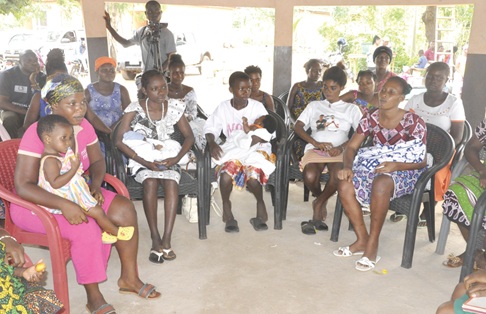
Later, at the Ave-Xevi CHPS compound in the Akatsi North District, the nurse-in-charge, Fafa Doh, said pregnant teenagers reported voluntarily to the facility to give birth safely, without resorting to terminating the pregnancy.
“They all want to go back to school and go into apprenticeship, after we counsel them,” she added.
Meanwhile, she said, the CHPS compound needed a bigger space to operate in.
The nurse-in-charge said Ave-Xevi had a population of 3,200, including a large number of adolescents who were among the facility’s clients.
Ave-Dakpa
The tour ended at the Ave-Dakpa, also in the Akatsi North District, where Dr Tetteh entreated the girls not to cut their dreams short through irresponsible sexual activities.
The Deputy (Country) Representative of UNFPA, Emmily Naphambo, said one of the principal objectives of GAP was to enhance informed decision-making among adolescent girls regarding their sexual and reproductive health.
“It is also to increase access to adolescent-friendly sexual and reproductive health services, ensuring gender-responsive and comprehensive care.”
