
Small-scale fishers across Ghana’s four coastal regions are pushing for a greater role in decisions on fisheries management, arguing that many of the challenges threatening the sector can only be addressed when fishing communities are actively involved in finding and implementing solutions.
The call was advanced through the Small-Scale Fisheries Academy in Ghana, an initiative designed to bring fishers, fish processors, canoe owners, chief fishermen, crew members and other stakeholders together to identify problems affecting the sector and develop community-led responses.
The academy, jointly organised by the Canoe and Fishing Gear Owners Association of Ghana (CaFGOAG) and Mundus Maris, was seeking to extend its community dialogue from the current eight fishing communities to 20 communities.
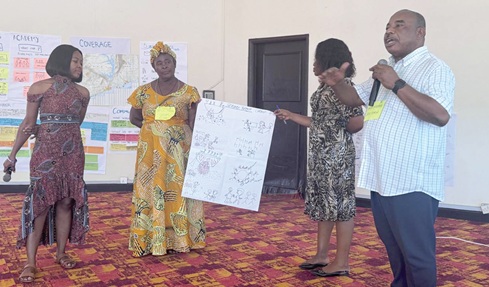
At the second session of the academy in Elmina, 35 participants drawn from the Central, Western, Greater Accra and Volta regions were trained in community facilitation, dialogue, leadership and participatory approaches to fisheries management.
The initiative was being implemented in collaboration with the Fisheries Commission and the Ministry of Fisheries and Aquaculture, with support from partners including Blue Ventures.
The General Secretary of CaFGOAG, Kenneth Arthur, noted that the academy was based on the principle that fishers themselves have an important role to play in addressing the problems confronting the artisanal fisheries sector.
“There are a lot of issues in the artisanal fisheries sector that we have tried over the years to find solutions to. As fishers, we believe that the solution is with the fishers,” he said.
He said the academy therefore provided a platform for the major actors in fishing communities to sit together, discuss their challenges and develop solutions that reflected their experiences.
Mr Arthur stated that small-scale fisheries remained critical to the economies of coastal communities because many households depended directly or indirectly on fishing activities.
He identified the use of explosives and chemicals, unapproved fishing gear and the harvesting of juvenile fish among practices affecting the sustainability of the sector.
He said the use of fishing gear with very small mesh sizes allowed juvenile fish to be caught before they have the opportunity to mature and reproduce.
“When that happens, it means the future stock that needs to grow to a certain length is what you have taken off,” he said.
Co-management
He added that climate change and competition from industrial fishing fleets were also putting pressure on the fish stocks targeted by artisanal fishers.
According to him, small-scale fishers depended heavily on small pelagic species, many of which are found in the inshore waters.
The President of Mundus Maris, Dr Cornelia Nauen, said effective fisheries management depended on creating legitimate avenues for fishers and other community actors to contribute their knowledge to decision-making.
She noted that one of the strengths of Ghana’s current direction in fisheries governance was the emphasis on co-management, which brought government institutions and fishing communities into the management process.
Dr Nauen noted that fisheries management could fail even where scientific information was available if the people who depended on the resources were not given meaningful opportunities to contribute.
She added that fishers and women involved in fish processing and marketing possessed detailed knowledge gained from their daily activities on the water and along the beaches which could be utilised for the growth of the sector.
Fisheries Commission
The Central Regional Director of the Fisheries Commission, Emmanuel Kwame Dovlo, described the academy as an important learning and dialogue platform for strengthening fisheries co-management.
He said the co-management principle was consistent with the direction of fisheries governance under the Fisheries and Aquaculture Act, 2025 (Act 1146).
The National Administrator of CaFGOAG and Western regional facilitator, Kwesi Benyi Randolph Johnson, said the programme has changed the way participants approached sustainable fisheries advocacy.
