
Sixteen African countries across all regions are currently experiencing sustained armed conflict, state fragility and military instability that significantly threaten the continent’s progress, the African Union High Representative for Silencing the Guns, Dr Mohamed Ibn Chambas, has said.
He said depending on the metrics used, the number might be higher, explaining that the instability was driven mainly by intra-state conflicts, civil wars, systematic abuses of power, unconstitutional changes of government, inter-faith and intra-religious tensions, ethno-tribal communal disputes and sheer acts of terrorism.
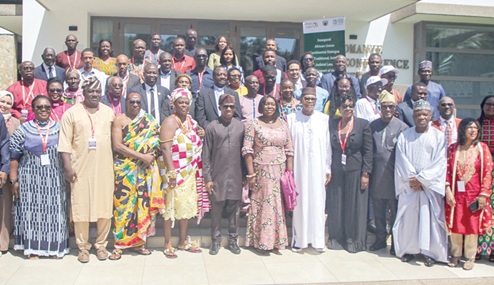
Dr Chambas said this in Accra yesterday at the inaugural continental dialogue with traditional, inter-faith and judicial leaders in support of the implementation of the AU Silencing the Guns (STG) Initiative.
He said Africa today stood at a critical juncture, explaining that despite holding extraordinary promise, rich in human capital, cultural diversity and economic potential, it was equally confronted by persistent and evolving challenges that threatened its progress.
He added that across the continent, conflicts, both old and new, continued to erode trust, destabilise communities and hinder development.
“Conflicts are no longer confined to conventional battlefields. Increasingly, they are rooted in complex social dynamics, fuelled by inequality, identity-based tensions, misinformation/disinformation, abuse of artificial intelligence and the manipulation of values that should otherwise unite us,” he explained.
Silencing the Guns
Conceived in 2013, STG is a flagship initiative of the AU aimed at ending all wars and civil conflicts and ensuring peace becomes a reality for Africans by 2020. That was not fully realised, so it has been extended to 2030.
Dr Chambas said peace in Africa could not be secured by governments alone but must be built from within societies, nurtured in communities and sustained by those who commanded trust, legitimacy and moral authority.
He said religious leaders, scholars and traditional authorities were uniquely positioned to provide that moral compass as their influence reached deep into society, making their role indispensable in countering violence, promoting reconciliation, building peaceful communities and silencing the guns.
Touching on women, the revered diplomat said that as architects of resilience, mediators of conflict and pillars of community stability, any strategy that did not place women at its core was incomplete and ultimately unsustainable.
On Silencing the Guns, Dr Chambas said it must address not only the manifestations of conflict but their root cause.
Peace begins in communities
The Deputy Minister of Local Government, Chieftaincy and Religious Affairs, Rita Naa Odoley Sowah, said while significant efforts had been made at the national and regional levels regarding the initiative, it must be acknowledged that sustainable peace begins in the communities when all stakeholders were involved in the peace-building process.
She explained that it was at the community level that conflicts emerged and grievances were first felt.
She urged Metropolitan, Municipal and District Assemblies to work closely with traditional and religious leaders to identify emerging conflicts, facilitate mediation and promote community-led solutions.
The Commissioner for Political Affairs, Peace and Security of the AU, Bankole Adeoye, said the dialogue was important because it was the first time that the AU was adopting a strategy of a global society approach to silencing violence.
He said despite modest gains, the truth was that the AU was still unable to silence violence on the continent.
“There are huge gaps and millions of our people continue to live with the reality of terrorising violent experiences, insolvency, suppression, national organised crime and other forms of security threats,” he said.
A Court of Appeal judge who represented the Chief Justice, Justice Sophia Rosetta Bernasko Essah, said many conflicts began, evolved and were resolved within communities, explaining that long before a matter reached the courtroom, police station or government office, it often began with a misunderstanding between neighbours, a dispute over land, a disagreement within a family, or tensions within groups that had lived together for generations.
When such disputes were left unresolved, she said, they could grow into larger conflicts, and that was why the role of traditional leaders, religious leaders, community elders, women leaders and youth leaders remained indispensable.
