
Ghana has taken a major step towards safeguarding its maritime domain with the introduction of the Maritime and Related Offences Bill, 2026.
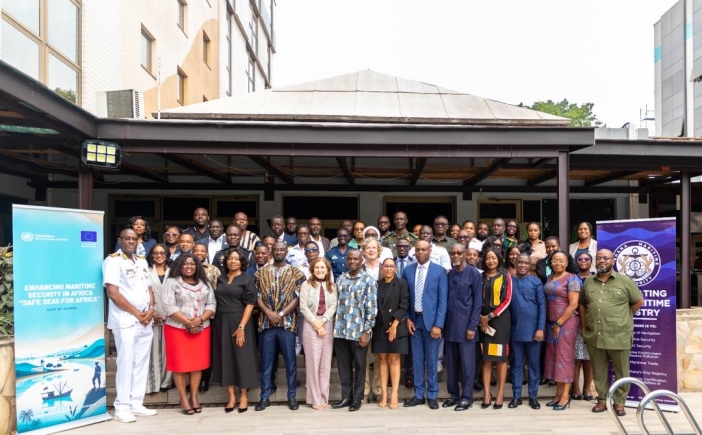
To prepare key institutions for the implementation of the proposed legislation, the Ghana Maritime Authority (GMA), in collaboration with the United Nations Office on Drugs and Crime (UNODC) and the European Union (EU), organised a two-day stakeholder sensitisationa workshop in Accra from August 5 to 6, 2026.
Held under the theme “Enhancing Maritime Security in Africa: Safe Seas for Africa,” the workshop brought together senior representatives from the Ministry of Transport, Ghana Maritime Authority, Ghana Navy, Ghana Air Force, Marine Police, Attorney-General’s Department, and other key actors within Ghana’s criminal justice system.
The engagement sought to deepen stakeholders’ understanding of the new legal framework and strengthen preparedness for its implementation.
Strengthening Ghana’s maritime legal regime
Delivering the welcome address on behalf of the Minister for Transport, Joseph Bukari Nikpe, the Chief Director of the Ministry of Transport, Mr. William Kartey, highlighted the Ministry’s commitment to positioning Ghana as a leading maritime hub within the sub-region. He noted that achieving this ambition requires a legal framework that is aligned with international maritime laws and conventions.
Mr. Kartey commended the Ghana Maritime Authority, the European Union, and UNODC for spearheading the workshop and advancing efforts to strengthen maritime governance and security in Ghana.
Responding to emerging maritime threats
In his remarks, the Deputy Director-General of the Ghana Maritime Authority, Mr. Mubarick Masawudu, underscored the importance of the Maritime and Related Offences Bill in addressing evolving security threats within the maritime sector.
According to him, while the maritime industry remains a vital contributor to Ghana’s economy, it is increasingly vulnerable to complex criminal activities such as piracy, armed robbery at sea, human and drug trafficking, and other forms of transnational organised crime.
“The Bill represents a significant milestone in Ghana’s efforts to strengthen its legal and institutional framework for combating maritime crime,” he stated. “A comprehensive legal regime is critical for effective investigations, successful prosecutions, and seamless coordination among law enforcement agencies. This legislation provides the clarity, certainty, and modern legal tools required to effectively suppress maritime crime.”
Mr. Masawudu further explained that although the Bill has been passed by Parliament and is awaiting Presidential assent, continuous stakeholder engagement remains essential to ensure its successful implementation.
EU reaffirms commitment to maritime security in Africa
Speaking on behalf of the European Union, Mr. Jean-Pierre Bardoul, Programme Officer in the Governance Section, highlighted the EU’s support for strengthening maritime law enforcement capacities across the Gulf of Guinea through the Safe Seas for Africa Project, implemented in partnership with UNODC.
He explained that the initiative seeks to improve the prevention, investigation, and prosecution of piracy and other maritime crimes, including drug trafficking.
He noted that the Maritime and Related Offences Bill represents a significant advancement in Ghana’s efforts to combat maritime crime and enhance regional maritime security.
Mr. Bardoul also observed that the Bill aligns with key provisions of the United Nations Convention on the Law of the Sea (UNCLOS), providing local courts with clearer jurisdictional authority and helping to address previous prosecutorial challenges.
UNODC supports legal reforms and rule of law
Representing UNODC, Mr Francis Izegaegbe Omionu, Associate Programme Management Officer, described the workshop as another important milestone in the organisation’s ongoing support for Ghana’s criminal justice system.
Through the Safe Seas for Africa Project, UNODC continues to provide technical assistance aimed at strengthening legal and institutional mechanisms for addressing maritime crime.
Mr Omionu commended Ghana’s efforts to reform its maritime legal framework, describing them as “commendable and a positive step in the right direction.”
He noted that the workshop aimed to examine measures for criminalising and deterring maritime offences, increase awareness of the international and regional legal frameworks underpinning the Bill, and highlight the critical role of safe and secure shipping in promoting national economic development.
She reaffirmed UNODC’s commitment to supporting Ghana’s criminal justice institutions in strengthening the rule of law through effective legislation and enhanced enforcement mechanisms.
A safer maritime future for Ghana
The Maritime and Related Offences Bill, 2026, marks a significant advancement in Ghana’s efforts to build a secure, resilient, and internationally compliant maritime sector.
By equipping law enforcement agencies and the judiciary with modern legal tools, the legislation is expected to strengthen the country’s capacity to prevent, investigate, and prosecute maritime crimes while contributing to safer seas and sustainable economic growth.
