


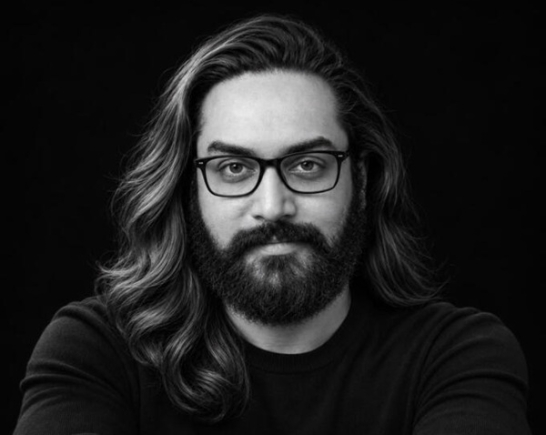
For Canadian author Amrinder Sahota, that sentence came from his great-grandfather when he was barely four or five years old.
“I remember my great-grandfather saying, ‘We lost in Mahabharata’,” he recalls.
Although he was too young to fully understand the significance of the statement at the time, the words remained in his memory. As he grew older, they became a source of curiosity about his family's past, its ancestral connections and the stories passed down through generations.
That childhood recollection would eventually provide the inspiration for a body of literary work exploring Punjabi heritage, family identity, mythology and the complexities of human relationships.
Sahota's writing journey is particularly interesting because it moves between different literary genres, including family-history nonfiction, mythology-inspired fantasy, dark fantasy and time-travel mystery.
Rather than limiting himself to one genre, he uses different storytelling approaches to explore a recurring question: how do the stories inherited from previous generations shape the way people understand themselves and the world around them?
Searching for his roots
One of his significant works, Sun and Moon: One Tree, Many Names, grew out of his desire to understand his family's history.
What began as a project to document his family's story developed into a wider exploration of Punjab's heritage, ancestral traditions, identity and belonging.
The book's central search is framed around four names: Suhotra, Sahotra, Sahota and Sihota. Through these names, family memories and traditions, Sahota examines the connections between ancestry, historical accounts and the identities people inherit.
His exploration takes readers through Punjab's villages, inherited stories, traditions associated with the sun and moon, and changing religious identities.
However, the book is not simply an attempt to establish a family lineage. It also raises questions about how people interpret their past and what they choose to carry into the future.
One of the central reflections running through the work is how generations can preserve the courage and positive values of their ancestors without inheriting their prejudices and historical grievances.
For Sahota, family history is therefore not only about discovering where one comes from but also understanding how that knowledge can influence one's present and future.
He is also careful to distinguish family traditions and oral accounts from independently documented historical evidence, recognising that inherited stories can provide important clues without necessarily proving an unbroken ancestral connection.
From history to imagination
His research into his ancestry eventually opened another creative door: fiction.
As he investigated the lives and experiences of his ancestors, he began imagining what it would be like to live alongside them and experience their world.
That curiosity inspired Mrig: Reborn in the Mahabharata, Volume 1, a fantasy novel that draws on the cultural and mythological world of the ancient Indian epic.
The story follows Harmin Sahota, whose search for his family's past takes him from Canada to his grandfather's village. His discovery of a hidden chamber leads to an extraordinary experience in which he awakens in another life as Mrig, a child in the world of the Mahabharata.
The novel explores what happens when someone familiar with the future of legendary figures finds himself growing up alongside them.
Rather than presenting the epic's characters only as established heroes and rivals, Sahota imagines them as children whose friendships, relationships and choices are still unfolding.
The story examines childhood, friendship, foreknowledge and the consequences of power.
For the author, the creative challenge was to imagine what it would mean to know the future of people who were becoming one's friends.
It is an imaginative interpretation inspired by the Mahabharata, rather than a translation or historical account of the epic.
Exploring darker worlds
Sahota's creative interests have also taken him into adult dark fantasy.
His novel, The Kindest Hunger, imagines a world set thousands of years before the Mahabharata. He is careful to explain that this is a fictional setting rather than a claim about established historical chronology.
The story follows Neral, a bone-healer whose ability to relieve people's suffering gradually becomes entangled with dependence, devotion and the pursuit of power.
Neral initially earns people's trust through his ability to heal them. However, an extraordinary source of strength and an unfinished ritual introduce a darker dimension to his growing abilities.
As his hunger for power increases, the relationships he has built become vulnerable to exploitation.
Through this character, Sahota explores the complicated relationship between kindness, dependence, power and the human desire for acceptance.
The book, released in November 2026, represents another direction in his exploration of imaginative worlds and the moral choices that shape individuals.
Beyond mythology
His literary interests are not confined to ancestral stories and fantasy.
Another work, The Day She Wasn't Dead, is a standalone time-travel mystery, demonstrating his willingness to explore different narrative structures and storytelling possibilities.
The diversity of his works reflects an interest in examining human experiences through different settings, periods and fictional circumstances.
Whether exploring the uncertainties of family history, the relationships between legendary characters or the consequences of extraordinary abilities, Sahota returns to questions of identity, memory, choices and belonging.
His work also creates an interesting connection between the past and the present.
In Sun and Moon: One Tree, Many Names, he examines the stories people inherit and how they understand their origins. In Mrig: Reborn in the Mahabharata, he uses reincarnation and mythology-inspired fiction to imagine what it might mean to encounter the past in an entirely different way.
In The Kindest Hunger, he moves further into an imagined world to explore the moral consequences of power and dependence.
These different approaches allow him to engage readers interested in cultural heritage, family history, mythology, fantasy and mystery.
A continuing literary journey
Sahota's writing journey demonstrates how personal curiosity can develop into a sustained creative pursuit.
What began with a young boy trying to understand an unusual remark by his great-grandfather has grown into an exploration of family memory and imaginative storytelling.
His work also raises a broader question about the relationship between heritage and identity: how much of who people become is influenced by the stories they inherit, and how much is determined by the choices they make themselves?
For Sahota, revisiting the past does not necessarily mean accepting every inherited belief or grievance. It can also mean examining those stories, separating memory from established history and deciding which values deserve to be preserved.
From documenting Punjabi family traditions to reimagining characters from the Mahabharata and creating entirely fictional worlds, he continues to explore the possibilities of storytelling.
And perhaps the most interesting aspect of that journey is that it began with a few words spoken by an elderly relative to a curious little boy.
A memory that might easily have faded has instead become the foundation for stories that connect generations, cultures and imagined worlds.
Writer's email:
