
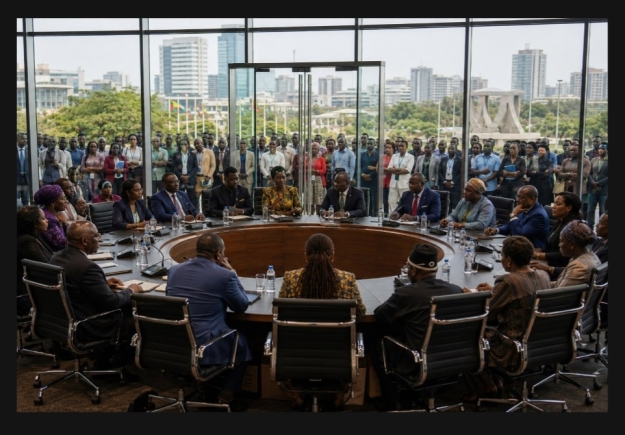
Every reparations conference eventually arrives at a question it cannot diplomatically dissolve, no matter how carefully the agenda is written. Who, exactly, belongs in the room when the conversation turns to repair.
The High- Level Consultative Conference in Accra arrived at that question almost immediately, because Kwesi Pratt Jnr, writer of book “Reparations: History, Struggle, Politics and Law”, General Secretary of the Socialist Movement of Ghana and Coordinating Committee board member of the Pan- African Progressive Front, refused to let it pass quietly.
Pratt did not soften his objection. Speaking to a hall filled with heads of state, scholars and diaspora representatives, he stated that he found the participation of the President of France, Emmanuel Macron, in the meeting totally unacceptable. This, he insisted, “should not be a forum for hollow expressions of sympathy and the propaganda of perpetrators of the crimes” for which we demand and seek repair. It is a serious and solid charge.
At the same gathering, Ms. Christiane Taubira, Former Minister of Justice of the French Republic, offered a meditation on reparations that approached the same history from an entirely different angle, one shaped by her own legislative legacy as the architect of France's 2001 law recognizing slavery as a crime against humanity. Taubira drew an angle in her address that deserves to be read carefully. She insisted on separating what she called Reparation, written in the singular with every letter capitalized, from reparations, written in the plural and lowercase. The first, she argued, refers to the crime itself, and it is absolute and irreparable. There exists no word equal to possible reparation of this crime, she said. There exists no authority capable of repairing this crime. There is no power, no wealth, no patrimony that could repair this crime. The only reparation that was ever possible, she continued, was carried out by the very people who were captured, chained and reduced to slavery, in their refusal to renounce their dignity.
It is a striking admission for a French official to make on a stage of this magnitude, that her own government's capacity to repair the crime is, in the deepest sense, nonexistent and this further underscored that Macron's video address was nothing other than an attempt to restore France's tarnished image. But Taubira turned immediately to reparations in the plural, the concrete and material kind, and she did something many in her position have historically avoided. She named the historical record plainly. She reminded the hall that when the slave trade was abolished, indemnities were paid, not to the enslaved, but to the former slave owners and colonial property holders, compensation for the loss of human property. And she reminded the room of the particular cruelty of Haiti's history, how the nation born of a victorious uprising against slavery was made to pay what she called, in legal terms, an odious debt to its former colonial power, a debt newly independent colonized nations inherited before they had even finished becoming nations.
This is precisely the kind of historical honesty Pratt demanded in his own address, when he insisted that the principal architects, organizers, financiers and beneficiaries of the Trans- Atlantic Slave Trade were specific institutions, not abstractions, and that their successors cannot enjoy inherited wealth while rejecting inherited responsibility. Ms. Taubira, speaking for the French Republic, conceded almost exactly this point, naming the indemnities and the odious debt as historical facts rather than disputed grievances.
Acknowledging history is not the same as being entitled to author its resolution. Taubira herself seemed aware of this danger, proposing that any honest conversation about repair must rest on three conditions, a shared commitment to the principle that all law, in every tradition, holds that wrongdoing demands reparation, a shared ethic concerned not with abstract morality but with what is good and what is just, and finally, in her words, franchise, meaning candor, the willingness to speak plainly even when the conversation is uncomfortable.
Candor, by Pratt’s account, does not mean accepting France's presence at the podium as evidence of good faith. It means insisting that the conversation be led, structured and ultimately judged by those who suffered the crime, not by those explaining their relationship to it, however eloquently. Taubira closed her remarks with a warning of her own, borrowing from the poet Aimé Césaire to insist that the words spoken by Africa and its diaspora at gatherings like this one are not idle, are not, in her phrase, marmonneurs de mots, mere mutterers of words, but words of fresh blood, capable of becoming flambées de chair, flares of flesh, if dialogue is refused. Dialogue, she said, or our words will remain flares of flesh and flares of the city.
It is a warning that, read in the context of Pratt's objection, cuts in the same direction. It is a caution against impatience, but it is also, perhaps unintentionally, an admission that patience has limits, and that the people gathered in that hall are not bound to wait indefinitely for nations to decide how candidly they wish to engage with the crimes their own history committed.
The Accra conference placed the dialogue, unambiguously, on the record. Pratt's objection and Taubira's confession are not opposites so much as two honest responses to the same impossible question, what does it mean for those who built the machinery of enslavement, or their direct political descendants, to participate in deciding how it should be repaired.
Pratt said, “I insist that reparations must be understood not as charity, but as justice; not as a sentimental appeal, but as a political, legal and historical necessity; not as a narrow demand for compensation alone, but as a comprehensive programme of repair, transformation and liberation. The book reminds us that the demand for reparations is rooted in memory, but it is directed towards the future. It is about correcting historical theft, but also about restructuring the conditions that continue to reproduce African underdevelopment.”
The answer the world settles on, whether through the legal panels Ghana has now established or through the continued insistence of voices like Pratt's that perpetrators cannot also be authors of their own absolution, will shape whether reparatory justice becomes a genuine transfer of power and resources, or simply a more sophisticated form of the same old arrangement, told this time with better manners and warmer language.
