
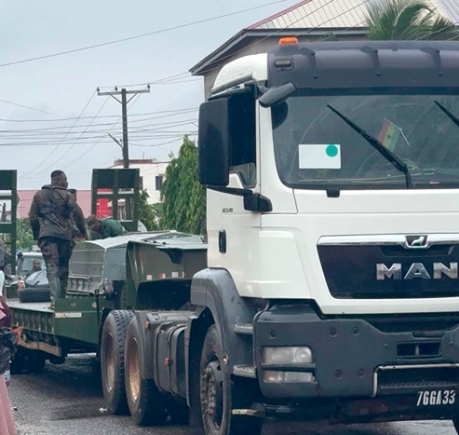
An image I saw during the floods of Monday, June 29, 2026, showing a military loader transporting a rigid inflatable boat (RIB) to rescue people stranded by floodwaters, vividly illustrates the complexities surrounding debates on defence expenditure.
It challenges the often rigid distinction between "defence" and "non-defence" spending by demonstrating how military assets acquired primarily for national defence and security operations can simultaneously fulfil critical humanitarian and disaster-response functions.
In this case, the same military capability intended for national security is deployed to save civilian lives during a climate-related emergency.
This example raises an important policy question: should defence budgets be assessed solely on their contribution to conventional military preparedness, or should they also be evaluated in the broader public value they generate through humanitarian assistance and disaster relief?
As climate change increases the frequency and intensity of extreme weather events, including urban flooding, the traditional boundaries between defence, civil protection, and public safety are becoming increasingly blurred.
Consequently, debates on military expenditure must recognise that investments in military capabilities may simultaneously strengthen national security and enhance societal resilience to climate-induced disasters.
Rather than framing the debate as one of "too much" or "too little" defence spending, the more pertinent question is whether defence investments deliver value for money across the full spectrum of their uses.
If military assets contribute not only to deterrence and national security but also to disaster response, humanitarian assistance, infrastructure support, and search-and-rescue operations, then assessments of defence expenditure should account for these wider societal benefits.
Such a perspective does not imply that all defence spending is justified; rather, it calls for a more nuanced evaluation that considers effectiveness, efficiency, accountability, and the multiple public goods that defence capabilities can provide.
The overlap between defence and non-defence expenditure is not new.
Militaries have long been called upon to assist civil authorities during natural disasters, humanitarian crises, and public emergencies.
However, climate change is likely to make these overlaps increasingly frequent and more pronounced.
As the intensity and frequency of floods, wildfires, droughts, storms, and other climate-related disasters increase, military assets may be deployed more regularly for domestic disaster response than for their traditional war-fighting roles.
Consequently, the conventional boundaries between defence spending and civilian public expenditure will become progressively more blurred.
This evolving reality opens an important avenue for academic enquiry and policy debate.
It invites scholars and policymakers to reconsider how defence budgets are conceptualised, justified and evaluated.
Rather than viewing defence expenditure solely through the lens of external security and military preparedness, there is a compelling case for assessing it as an investment in broader national resilience.
This requires new frameworks for evaluating defence spending that capture its contribution not only to national defence but also to disaster preparedness, emergency response, climate adaptation, and the protection of human security.
As climate risks intensify, the debate may shift from asking how much countries spend on defence to how effectively defence capabilities generate value across both military and civilian domains.
Writer’s Email:
