
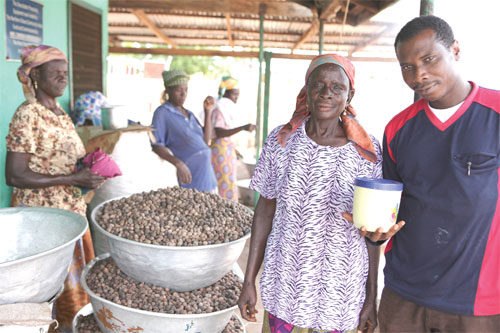
 One cannot stay in northern Ghana without encountering the shea experience. If you are lucky to be there around May you would enjoy the sweet, soft plum-like fruit. You might have the option of having a snack fried in the healthy butter to enjoy.
If you ask, you might even see an aspect of the process from dried seeds to pomade.
Then there is the sheanut tree itself. Thick-trunked and heavily-leafed, it appears like the oak tree. The shea species thrives naturally in the Upper east, Upper West and Northern Region of Ghana. It is hardly cultivated and grows wild across the northern belt.
Local experts estimate that there are about 10 million shea trees standing in this area.
One of my earliest shocks about shea butter cream happened at the university. The guy with the blackest and shiniest hair was asked what he used; his answer baffled me, shear butter.
In my mind I thought it ended there, until recent testimonies from others came in.
It is a magic product. More importantly, Ghanaian culture holds the shea butter in high regard. Remember the last time your mother, wife or sister needed it, insisting that nothing else would do?
The charm of the product and its reputation made me bring it up in my itinerary. So, while I was in these parts I scurried up to Tamale. Then continued 15km to a small town called Mbamayili.
First of all, I found out that shea business is she-business as every aspect of the process is done by women. It is a serious livelihood matter in the three northern regions and the local women exercise full control.
At Mbamayili, the women run a cooperative of a sort. Here they call shea butter Kpakah-kali and in many ways is their cocoa.
The setup is well resourced. One sees the process from the moment the dried shea seeds are brought. It is a useful activity to observe and take part in. It could even generate revenue as tourists would love to be engaged in the process.
In the yard I noticed that they use a lot of water and fuel wood. There isn’t much use of heavy machinery. Typically, the process involves collecting the shea fruit, removing the pulp and cracking the kernel.
The next phase involves pounding the nut, roasting and then it is time to send it to the grinding milling. After that water is added and the resultant paste is beaten for an hour. They do this while adding more water.
At this stage one begins to see the cream. The cream is then rinsed after which skimming and then boiling takes place. The oil that is produced is left overnight to become butter.
The women learnt the skill from their parents. Seeing only one young lady of about 20 years there, I wondered whether today’s children are picking up the process.
At this point let me say that shea butter has been proven to have high value for the pharmaceutical, food and cosmetic industries.
Internationally, it is said to have amazing anti-aging benefits and if we have not yet made a cash crop out of produce, it is our own calabash of koko.
In East Africa, they are doing a great job serving the demand of the global market.
Shea butter has been known to work well against stretch marks. It also benefits those suffering dry skin, dermatitis and sunburn.
It has been claimed internationally to be an effective treatment for fading scars, eczema, burns, rashes, acne and severely dry skin. Others use it for nasal congestion as well as sinusitis. The list goes on.
Such a useful raw material. You can be sure that I left Mmabayili with one big jar of this magic cream. Go get yours, please.
Kofi Akpabli is a communications specialist and a consultant at TREC, a tourism and culture research group.
By Kofi Akpabli / The Mirror / Ghana
Writer's email:
