
“Life is tragic simply because the earth turns and the sun inexorably rises and sets, and one day, for each of us, the sun will go down for the last, last time.” — James Baldwin,
“Letter from a Region in My Mind,” The New Yorker, November 17, 1962; later collected in The Fire Next Time. I knew John Hyde for as long as I have had a memory.
He was a towering personality at the University of Ghana, or even more precisely for my purposes, in the Legon community, where I grew up.
A professor of mathematics; a courageous, outspoken and indefatigable leader of the associations that bound Ghanaian academics together, at a time when they were standing up to military rule.
John Hyde was one of those whose place in the battles against the “Ghanaian Gestapo” was the stuff of legend. My late father, also a professor named “John,” was a tough grader when it came to praise for scholars.
Only a few earned his unqualified praise – John Hyde was one of those.
Growing up, on several occasions, I would hear my father single out John Hyde for praise.
He described John Hyde as a man of exceptional courage, outstanding integrity and rare discipline. It was obvious, even to my young mind at the time, that my late father saw John Hyde as an unyielding and ineluctable conscience of academics.
A man willing to go the full lengths of exertion in defence of the highest standards of scholastic excellence.
As children, beyond eavesdropping on our parents’ animated conversations in what was the politically dangerous climate of the era, we formed our own independent impressions.
I knew John Hyde’s family well. His lovely wife, our Aunty Faustie, was a warm, welcoming and eversmiling woman, a mother to us all.
She was a scholar in English, which my young mind thought of as a subject I could comprehend, because I loved poetry.
To that young mind, she and her husband were a study in contrasts. There is nothing more terrifying to a young boy grappling with the mysteries of long-division in primary school, than being introduced to a man you are told has mastered the seemingly esoteric and extraterrestrial mysteries of advanced mathematics.
Anyone who found triple integral calculations easy had to be endowed with magical powers. Such a man, it seemed to me then, was Professor John Hyde.
He fit all my childhood caricatures of a mathematics professor. Prof. was every bit a no-nonsense man. Never extravagant with his words, he was focused, very precise in all his ways, and had little tolerance for trivia and distractions.
Every bit of his gangly frame oozed Spartan discipline, a very serious man indeed. Truth be told, I saw him as a man not to be crossed, even somewhat intimidating.
That now seems like a very long time ago. The boy did become a man. Life taught me many lessons, for my adult experiences of the man did explode the sense that John Hyde was either aloof or soulless.
Yes, he had no time whatsoever for much of the unproductive noise that regularly distracts many Ghanaians, and for that matter Africans, in our daily endeavours.
He was a serious man who remained passionate about knowledge and our need for development to the very end. This was not a man in search of publicity or even earned glorification, he shunned it actually.
He was willing to pursue the harder right than to seek cheap popularity by avoiding difficult truths. He woke up every morning determined to use his commitments to seek truth from science and facts, in a never-ending search for solutions that could improve the well-being of the generality of his compatriots.
Poverty, ecological destruction from illegal mining (Galamsey), under-development, the ever declining standards of education, official corruption, these burdened him.
He never stopped talking to me about how it was important to build cultures of excellence that would propel the majority of our people into a better life of real dignity.
Through our frequent conversations, I discovered the pulsating heartbeat of a true humanist, in every positive sense of the word. He was never captive to simplistic orthodoxies, John Hyde followed the path of integrity wherever it led. I found him very intellectually honest.
He loved a diligent debate, one where facts and solid evidence were deployed alongside meticulous reasoning. An outstanding scholar himself, belonging to my own father’s generation and therefore much older than me, he never pulled rank. It did not take me long to realise he was not acting in a performative way when he would say he wanted an honest view on something.
Even in his own field, he was willing to change his mind, if you convinced him. But that democratic tolerance imposed responsibilities on people in my position. His standards of scrutiny were high, very high.
This was not a man to be engaged with vibes and banter, you would not get far with John Hyde if intellectual laziness characterised your ways. He was an eclectic scholar, with deep interdisciplinary interests in societal development. A voracious reader with incredible amounts of energy, to the end, he would share the latest scholarly articles and other publications in many of our mutual interests with me. John Hyde loved that I would read them and get back to him with my views.
Always he had read them himself, and we would discuss at length – from the humanities to the sciences, from political economy to physics, from geopolitics to domestic politics, and much more. John Hyde was relentless in his search for knowledge that could improve the human condition. I learned so much from this man.
He encouraged me, he challenged me, he stretched me, he inspired me. Some of his own nuclear family started to call me “Prof.’s additional son.” A few of my friends saw me as his principal mentee and said so. Interestingly, John Hyde himself never referred to any form of hierarchy in his dealings with me, be they scholastic, ageist, or anything else. Way his junior on all these axes, he always simply referred to me as, “my good friend.”
This was a role model in intergenerational productive partnerships. He was democratic, respectful, challenging when he needed to be, but also full of encouragement. An inspirer if ever there was one. On 19th June 2025, I was due to deliver an important public lecture.
Though he was very happy to hear I had been selected to do this, I chose not to disturb him with an invitation, thinking I would let the old man rest and send him the recording later.
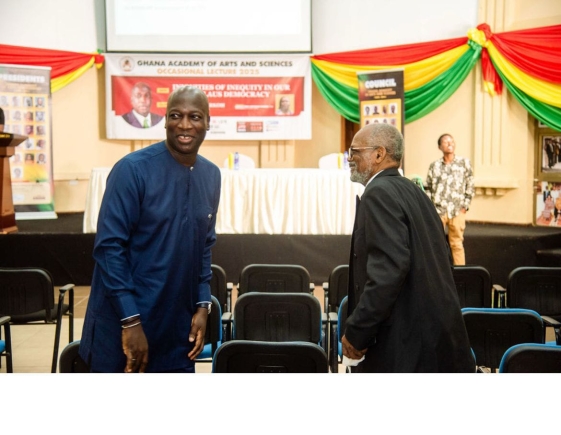
He was very digitally savvy, introducing me to several news apps regularly, a kind of octogenarian Gen Z. Imagine my total surprise when about forty minutes before the start of the event, there came John Hyde into the hall. Formally dressed, drawing no attention to himself, even when the whispers started among younger academics that “Nsarkoh had succeeded in bringing John Hyde (himself!) to the event,” he quietly took his seat.
For a while, a few minutes that is, I was speechless, totally overcome by emotion. Then I rushed to him to say thank you, knowing he had not been too well only days before.
In typical John Hyde fashion: no drama, no pomposity, no airs, tremendous humility, he smiled and said simply to me: “my friend, I have not been too well, but I had to come – for you.” Unbelievable! He stayed till the very end of the event. When I rushed to thank him, accompanied by my wife, as he quietly slipped out of the hall, he told me not to make too much of a fuss about this.
Then promised that he would give me his comments, but only after he had watched the recording and ensured that his recollections were accurate. A few days after this, I received a generous review of the lecture, and very hearty congratulations.
That was John Hyde, a man of his word, always diligent, never a careless word. Alas, that day at the lecture, June 19, 2025, captured in the attached picture, was to be the last time I met him in person. This was not at all obvious to me then. We continued to exchange messages as usual, but somewhere in May or June 2026, it seemed to me that I detected a drop in frequency and energy.
I reached out to my classmate in both primary and secondary school, as well as childhood and lifelong friend, Mrs. Adriana Bedu-Addo, OT as we call her – the second daughter of John Hyde, to find out whether all was well. By this time I had started to call her “my friend’s daughter”, while she referred to me as her father’s son. OT tried not to alarm me, but she called a few days later to say things had taken a downward turn. We encouraged each other, leaving me in disbelief that at such a critical time, the Hyde family was so concerned about how I would react to the news; they were focused as much on my mental well-being as theirs. What selflessness.
Life has its twists and turns, sometimes in inexplicable ways. I had decided not to pummel Prof with messages, so he could get all the rest he required at this time. Yet, on the 14th of July, seemingly out of the blue, I received a text message from him.
As fate would have it, that now stands as his final goodbye to me, for six weeks later, on my birthday, he was gone to the land of the ancestors. Referring to himself, that message - I now realise - had prophetically said: “The alarm bells are ringing. Don’t ask for whom it rings. It rings for thee.” John Hyde was my hero, my inspirer, my role model, my kindred spirit, my friend and my mentor.
He gave me more than sufficient proof of two things: that the notion in our broken society that retirees have nothing to offer the development effort is pure hogwash; and, that intergenerational mentoring partnerships are vital in any country that recognises knowledge as the primary productive force.
Only a few years shy of being a nonagenarian, John Hyde was an everyday reminder to me of what scholarly excellence, at its very best, truly is.
A useful jolt in these days when at many levels our country is suffocating on the toxic fumes of mediocrity. He shared so much with me, so much.
He taught me to keep going, never to give up. For, till the very end he worked for his beloved country and continent. Yet, in our broken society, so many people draw a blank when his name is mentioned in relation to our struggles for democratic freedoms. A truly great man has passed on. Horace was right: “Heroes have lived before Agamemnon lived,
But all of them are lost somewhere in the night, Unwept, unknown, unless they had a poet, To tell what was their story.”
Thank you for everything, Prof, my good friend. Rest well, for you earned it with your work on earth. Here on earth for those of us who remain, we remember your good work, and it inspires us to say: A luta continua.
