

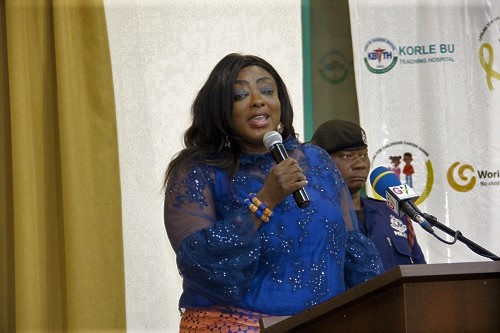
The Ministry of Gender, Children and Social Protection says it will champion the campaign to add childhood cancer to the list of illnesses covered by the National Health Insurance Scheme (NHIS).
It is estimated that only 20 per cent to 30 per cent of the over 1,200 children who are diagnosed with the disease annually receive treatment, with the survival rate of those that do not receive treatment estimated at no more than 20 per cent because of late presentation to a health facility, lack of funding, treatment abandonment, among other reasons.
A Deputy Minister for Gender, Children and Social Protection, Ms Freda Prempeh, who made the announcement at a fund-raising gala night in Accra last Saturday, said it was important to do so once breast and cervical cancer were on the list.
She said it was important to put the disease on the list to save the lives of children whose families could not afford the cost of treatment.
Organised by the Lifeline for Childhood Cancer Ghana (LCCG), the event was held to raise money to support families who could not afford the expensive treatment for the disease which affects the brain, eye, neck, limbs, testes, glands, abdomen and pelvis of children.
Treatment cost
On the night, survivors of the disease made a passionate appeal to the gathering at the Alisa Swiss Spirit Hotel in Accra, where the organisers raised GH₵114, 200 in cash and pledges.
The cost of treatment ranges from GH₵4,000 for drugs to GH₵25,000 for up to three years treatment for leukemia.
Earlier, reading a speech on behalf of the First Lady, Mrs Rebecca Akufo-Addo, Ms Prempeh said it was reassuring that childhood cancer could be cured if detected early.
She, however, said it was regrettable that awareness about childhood cancer, which affected the country’s future leaders, was woefully inadequate compared to that of breast and prostate cancers.
Ghana selected
The Head of the Paediatric Oncology Unit at the Korle Bu Teaching Hospital, Prof Lorna Awo Renner, said Ghana had been selected this year by the World Health Organisation (WHO) as one of eight countries in the world targeted in the first phase of the WHO Global Initiative for Childhood cancer.
The initiative is aimed at achieving 60 per cent survival for all children affected by cancer globally by 2030.
She said the country was selected because the WHO believed in Ghana’s capability to achieve the target.
Prof Renner noted that some of the common cancers that presented early in Ghana such as kidney cancer and eye cancer were already achieving at least 70 per cent long term cure.
Symptoms
The Executive Secretary of the LCCG, Ms Akua Sarpong, said the idea of the organisation began after she lost a child during treatment of the cancer.
“While in the hospital, I met so many parents who could not afford the cost of treatment. It was heart-breaking,” she said.
She encouraged parents not to take for granted any symptom of pain on their children but rather seek urgent medical attention for them.
Some symptoms of childhood cancer include continued, unexplained weight loss, headaches, often with early morning vomiting.
Increased swelling or persistent pain in the bones, joints, back, or legs, lump or mass, especially in the abdomen, neck, chest, pelvis, or armpits as well as development of excessive bruising, bleeding or rash.
