
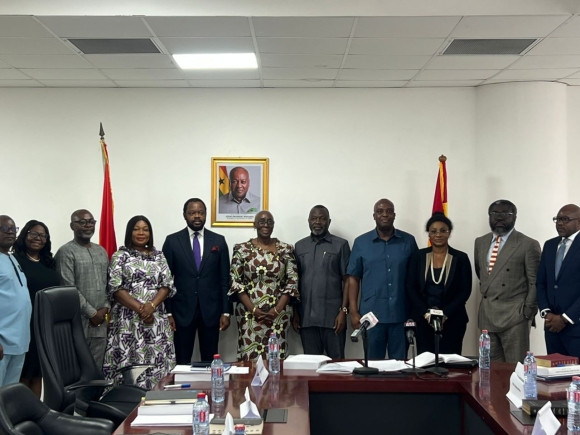
The Attorney-General and Minister of Justice, Dr Dominic Akuritinga Ayine has sworn in members of the Constitution Review Implementation Committee (CRIC) with a charge to translate accepted constitutional reform recommendations into laws and other measures for implementation.
The 11-member committee, chaired by legal practitioner Marietta Brew, was sworn into office at the Law House in Accra on Friday (August 28).
The other members are the Deputy Attorney-General, Dr Justice Srem-Sai, Deputy Finance Minister, Thomas Ampem Darko, Charlotte Osei, Dr Rainer Akumperigya, Emelia Ankomah, Samuel Passah, Oliver Barker-Vormawor, Salamatu Iliasu and Eric Owusu-Mensah, Kwame Anyimadu-Antwi.
The ceremony involved the administration of the official oath and the oath of the Constitution Review Implementation Committee by Dr Ayine.
November deadline
Dr Ayine said the committee has been given a time-bound mandate and was expected to have the first set of constitutional amendment Bills, particularly those dealing with non-entrenched provisions, ready to be laid before Parliament by November 2026.
He said the committee’s work would ultimately lead to some of the proposed constitutional amendments being subjected to a referendum alongside the 2027 district assembly elections.
“Your task is deliberately bipartisan and deliberately time-bound,” he said.
Dr Ayine said the government had already issued its position paper on the recommendations of the Constitutional Review Committee and had endorsed a substantial package of constitutional reforms.
He said a “zero draft” had also been prepared to assist the CRIC in its work.
He explained that the draft reflected recommendations accepted by the government and those accepted with modifications.
Implementation
The Attorney-General said the CRIC would have to align the recommendations accepted by the government with the government’s position paper and previous draft Bills prepared by an earlier implementation committee.
He said the work of the new committee was important because the recommendations of the Constitutional Review Committee represented the views of Ghanaians gathered through consultations across the country.
“What the committee gave us was not a technical document written for lawyers. It was the voice of the Ghanaian people on questions that touch every one of us,” Dr Ayine said.
He said those questions included how long a President should serve, the size of Parliament, how district assemblies should be elected and led, and how the fundamental rights and freedoms of citizens should be protected.
Dr Ayine said the country had done its part by stating what it wanted, while the government had also taken a position on the recommendations.
“What is left is the most exacting part, getting the drafting right, and doing it in a way that keeps fit with the consultations that got us here,” he said.
Committee’s mandate
The Chairperson of the CRIC, Marietta Brew, said the committee accepted the responsibility with an appreciation of its constitutional and historical importance.
She said the committee was not established to conduct another general review of the 1992 Constitution but to translate the recommendations accepted by the government into practical measures.
“Our responsibility is to translate the recommendations accepted by government into lawful, coherent and practical measures capable of implementation,” she said.
Mrs Brew said some of the reforms would require amendments to entrenched provisions and would therefore have to go through the referendum process, while others would require parliamentary legislation, subsidiary legislation, institutional reforms or administrative action.
