


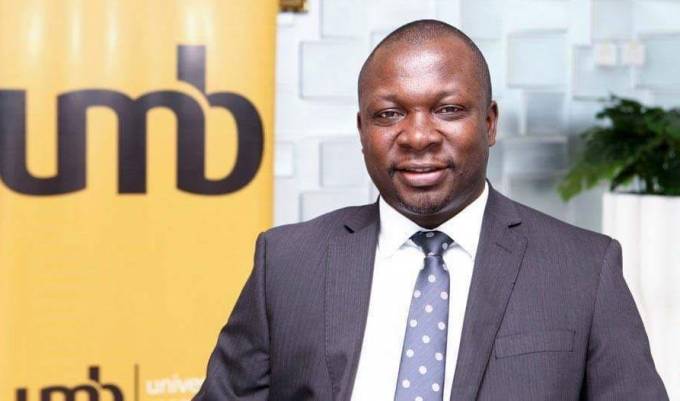
The overcrowded financial services sector with weak muscles is not good for the economy, the Chief Executive Officer (CEO) of Universal Merchant Bank (UMB), Mr John Awuah, has said.
He said the large number of universal banks operating in the country might not be in the long-term interest of the country.
Mr Awuah noted that while banks operating in the country were very keen to provide the necessary ammunition to positively propel the financial sector’s contribution to economic growth, a significant number of them did not have the required funding capacity to provide the financing needed for domestic large-scale projects.
“With non-existent or limited capacity to fund such large-scale and mostly infrastructure projects in the domestic market, the obvious funding sources have been the international banks and multilateral sources with all the trappings that come with those funds,” he said in an interview.
Mr Awuah noted that banks, with limited capital base and balance sheet size, in an attempt to provide some form of financial support for large-scale projects, engaged in exposure syndications as the only viable option domestically.
“The market squeeze may over a period of time push banks to improve on the levels of collaborations, but if the market is left to lead the change, the process for the creation of mega banks will be slow and painful,” he said.
Consequently, he indicated that regulatory overtures from the central bank could be a good push towards consolidation to enable banks operating in the country to use their financial resources to play their roles more effectively in the economy.
Banks in Ghana
There are about 30 universal banks, 65 non-bank financial institutions, 467 microfinance institutions, 67 money lenders, 11 financial NGOs, 140 rural banks and 392 forex bureaux operating in a country with a population of just about 27 million people. In the midst of these staggering statistics, available records indicate that more than half of the population remains unbanked.
It is a common phenomenon to the universal banks over-concentrated in the urban centres, especially Greater Accra and the Ashanti Region. Only a handful of banks are found in the northern parts of the country where economic activity is yet to boom.
Per the rules of the Bank of Ghana, the industry regulator, universal banks require about GH¢60 million (about US15.3 million using the present exchange rate of GH¢3.9) as the minimum capital requirement, while new entrants are expected to have GH¢120 million (US$30.7 million). This is as against US50 million required to set up in Nigeria, for instance.
Case for consolidation
“I think universal banks in Ghana are too many. We therefore do not necessarily need 30 banks to reach everyone; we only need banks that can have demonstrable capacity to meet the demands of the country,” he said.
“In Nigeria, for example, with a population of around 200 million, there are less than 25 banks. Previously there were 89 banks, but new capital requirements by their regulator resulted in mergers and acquisitions which reduced the number to 22 banks. Also, Canada has a population of between 35 – 36 million people, but they only have six commercial banks and one of them could absorb all of the banks in Ghana. So why not create a significant scale by joining forces?” he asked.
According to Mr Awuah, “regulation is the most effective way to achieve this.”
Mr Awuah is of the view that “eventually market forces will lead to consolidation; however it will be at a slower pace than if consolidation is driven by regulation. Regulation drives momentum”.
He further noted that Ghana was an economy that was on a growth trajectory and, therefore, banks should have the capacity to grow with the economy by facilitating that growth with their intermediation activities.
Mr Awuah said “It is a shame that none of the banks in the country were able to fully fund the Circle overpass project or the Kasoa interchange project, not because they were not willing to fund, but because they did not have the required financial resources to take on exposures and projects of such magnitude.”
“So I think that the market itself will move towards consolidation, but that will take a long time because there are so many factors that are involved. There is a prevailing viewpoint in Ghana that says that Ghanaian business people prefer to own 100 per cent of a company worth GH¢1 million, to owning 10 per cent of a multimillion dollar company. However, if regulation is driving consolidation over a period, that ideology will change,” he said.