


Ghana is entering a new phase of economic possibility.
After years of macroeconomic pressures, high inflation, exchange rate instability, elevated interest rates and financial sector stress, the economic environment in 2026 is showing important signs of repair. Economic growth has strengthened, inflation has fallen sharply, monetary conditions have improved, and the banking sector is expanding its lending to the private sector.
The Ghana Statistical Service reports that real Gross Domestic Product grew by 6.0 per cent in the second quarter of 2026, while inflation stood at 5.0 per cent in August 2026. The Bank of Ghana has also maintained the Monetary Policy Rate at 14.0 per cent following its July 2026 Monetary Policy Committee meeting, a dramatic improvement from the much higher policy rates recorded during the recent period of economic instability.
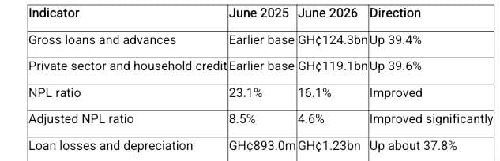
Yet beneath this encouraging picture lies a critical challenge. Ghanaian banks wrote off GH¢1.23 billion in loan losses and depreciation in the first half of 2026, up about 37.8 per cent from the GH¢893.0 million recorded in the corresponding period of 2025.
At the same time, the banking sector’s Non-Performing Loan ratio declined from 23.1 per cent in June 2025 to 16.1 per cent in June 2026. When fully provisioned loans are excluded, the adjusted NPL ratio fell from 8.5 per cent to 4.6 per cent.
The message is therefore more complex than either optimism or alarm. Ghana’s financial system is strengthening, but credit quality remains a crucial test of whether macroeconomic stability can translate into sustainable prosperity.
Stronger banking sector
The latest banking data presents an important paradox. On one hand, credit is expanding rapidly. Gross loans and advances increased by 39.4 per cent year on year to GH¢124.3 billion at the end of June 2026, compared with growth of only 5.5 per cent a year earlier. Credit to private enterprises and households increased by 39.6 per cent to GH¢119.1 billion. This is potentially transformational.
The challenge is ensuring that expanding credit produces economic value rather than creating another cycle of indebtedness.
The improvement in NPL ratios is significant. The headline NPL ratio has fallen by 7 percentage points, equivalent to a relative reduction of approximately 30.3 per cent. The adjusted ratio has fallen by 3.9 percentage points, representing a relative improvement of approximately 45.9 per cent.
Why are loans becoming delinquent?
Loan delinquency rarely has one cause. It is normally the result of a combination of borrower behaviour, business weakness, market conditions, credit underwriting and broader economic shocks.
1. Weak business cash flow:
A profitable business on paper can still default if customers delay payments, inventories remain unsold or operating expenses rise faster than revenues.
2. Poor financial planning:
Some borrowers take loans without sufficiently analysing repayment capacity, working capital cycles and interest costs.
3. Diversion of borrowed funds:
Credit intended for productive investment can be redirected towards consumption, unrelated businesses, personal expenses or speculative activities.
4. Market instability:
Exchange rate movements, changing commodity prices, imported inflation and unpredictable demand can undermine businesses that operate with thin margins.
5. High operating costs:
Energy, transport, logistics, rent, wages and input costs can erode cash flows and leave borrowers unable to service debt.
6. Weak corporate governance:
Poor accounting systems, inadequate internal controls, related party transactions and weak oversight can turn otherwise viable enterprises into credit risks.
7. Household financial pressure:
Families may borrow to finance education, housing, medical expenses, food, transportation and other essential needs, sometimes accumulating multiple obligations without adequate income growth.
8. Legacy economic shocks:
Some current NPLs originated during periods of severe inflation, exchange rate depreciation, high interest rates and economic uncertainty. Improving macroeconomic conditions do not immediately erase those historical liabilities.
The cure is not simply more lending
The answer to Ghana’s credit problem is not to discourage banks from lending. It is to improve the quality of lending.
The Bank of Ghana’s recent data is encouraging because credit growth is returning strongly to the private sector. This can strengthen economic activity through the familiar financial intermediation channel.
However, credit expansion without adequate risk assessment can eventually become a threat to financial stability. Banks must therefore distinguish between credit demand and creditworthiness.
A borrower wanting GH¢5 million is not necessarily a borrower capable of productively deploying and repaying GH¢5 million.
Financial discipline
Ghana’s improving economic environment creates an opportunity for a new culture of financial discipline.
For households, financial discipline should involve five practical principles.
1. Borrow according to repayment capacity: The size of a loan should be determined by sustainable income rather than the maximum amount a lender is willing to provide.
2. Separate needs from wants: Credit for productive assets, education or business expansion should be treated differently from borrowing for discretionary consumption.
3. Build emergency reserves: Households should gradually create savings that can cover unexpected income interruptions or major expenses.
4. Track all obligations: Individuals should maintain a simple debt register covering principal, interest, maturity dates, instalments and penalties.
5. Seek restructuring early: A borrower experiencing genuine temporary difficulty should engage the lender before the account becomes seriously delinquent.
Businesses require an even stronger discipline because corporate borrowing carries wider consequences.
1. Maintain accurate accounts: Financial statements should reflect the real condition of the enterprise.
2. Protect working capital: Businesses should avoid using long-term investment loans to finance persistent short-term operating losses.
3. Match financing with cash flow: The repayment structure should correspond with the timing of business revenues.
4. Control operating costs: Strong revenue growth can still produce financial distress if costs are uncontrolled.
5. Diversify markets: Dependence on one customer, supplier, product or geographic market creates vulnerability.
6. Strengthen governance: Boards and management must monitor debt, liquidity, profitability and covenant compliance continuously.
7. Create contingency plans: Businesses should stress test their finances against exchange rate movements, interest rate changes, declining sales and unexpected cost increases.
Macroeconomic stability
The most important opportunity is that Ghana now has a more favourable platform from which to address these weaknesses.
GDP growth of 6.0 per cent in the second quarter of 2026 demonstrates stronger economic momentum. Inflation at 5.0 per cent in August 2026 is considerably more conducive to business planning and household budgeting than the extremely high inflation environment experienced previously.
The Bank of Ghana’s financial stability assessment also indicates that the banking sector has substantial resilience. Its 2025 Financial Stability Review found that the banking industry appeared robust to plausible adverse macroeconomic developments, supported by capital buffers and improved macroeconomic conditions.
This creates opportunities for four major groups.
1. Government
Government can use improved financial stability to deepen economic transformation rather than merely manage crises.
2. Businesses
Businesses can now plan with greater confidence around prices, financing and demand.
The sharp increase in private sector credit indicates that banks are becoming more willing to support economic activity. The opportunity is to channel this financing towards productive sectors including manufacturing, agriculture, technology, logistics, tourism, construction and services.
3. Investors
Investors are particularly sensitive to macroeconomic stability because investment decisions depend heavily on predictable inflation, monetary policy, currency conditions and financial sector resilience.
Ghana’s improving banking indicators can therefore strengthen investor confidence. Indeed, the Bank of Ghana recently reported that Ghana's sovereign rating had been raised to B with a stable outlook, with improving banking sector stability and lower inflation cited among the factors supporting the assessment.
4. Households
Households stand to benefit through improved employment prospects, more stable prices, greater access to credit and stronger opportunities to accumulate assets.
Market vigilance
Macroeconomic stability should never be confused with the disappearance of economic risk.
Ghana remains exposed to global commodity prices, oil prices, international interest rates, geopolitical developments, exchange rate pressures and external financing conditions. Businesses that import machinery or raw materials remain exposed to currency movements. Exporters remain exposed to commodity price fluctuations. Households remain vulnerable to employment and income shocks.
Consequently, financial discipline must operate even when economic conditions appear favourable.
Conclusion
Ghana's 2026 economic story is increasingly one of recovery, opportunity and renewed confidence. Real GDP growth of 6.0 per cent in the second quarter, inflation of 5.0 per cent in August and a 14.0 per cent Monetary Policy Rate provide a considerably stronger macroeconomic foundation for households, businesses and investors.
The banking sector is also expanding its economic role. Gross loans and advances have grown by 39.4 per cent, while credit to private enterprises and households has increased by 39.6 per cent. At the same time, the NPL ratio has fallen substantially.
But the GH¢1.23 billion in loan losses is a reminder that financial stability must be protected through discipline.
Ghana's next economic challenge is therefore not simply to grow. It is to make growth financially sustainable.