


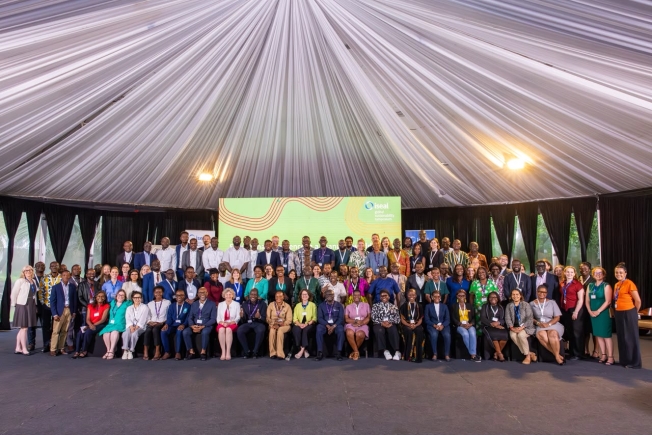
Switzerland's support for sustainable supply chain development in West Africa was placed firmly on the record on Tuesday, June 9, 2026, as the Deputy Head of Mission at the Swiss Embassy delivered a keynote address at the ISEAL Global Sustainability Symposium in Accra.
Janine Walz, Deputy Head of Mission and Head of Cooperation at the Embassy of Switzerland to Ghana, Benin and Togo, was among the day's keynote speakers, delivering a statement on the role of sustainability standards in building supply chains that serve producers as well as markets.
The Swiss State Secretariat for Economic Affairs supported the Symposium as part of its partnership with ISEAL, the global membership organisation for sustainability standards. The event brought together producers, policymakers, businesses and sustainability leaders from across the world to examine supply chain resilience in a changing global context.
Standards as a common language
In her address, Walz framed voluntary standards as tools of genuine policy significance. At a moment when the relationship between certification schemes and mandatory regulation is being actively renegotiated across European markets, she positioned standards as a common language shaped by the full range of supply chain actors.
"Standards and certification schemes play a critical role. As market-based tools, they define good practices and create a common language shaped by farmers, companies, NGOs and governments. One that influences policy and corporate commitments worldwide. They are already embedded in global markets and are well placed to drive socio-economic benefits for producers," she said.
Supply chain resilience in focus
The Symposium centred on the theme of supply chain resilience in a changing world, with discussions examining how voluntary standards can support producers and industry at a time of high global uncertainty.
The closing session examined how to better align policy and practice to support producers and small and medium-sized enterprises amid growing regulatory complexity, a theme directly relevant to Switzerland's development cooperation work in West Africa.
Need for coordinated action
The Symposium underscored that supply chain resilience requires coordinated action between governments, businesses, producers and sustainability systems, with credible tools connecting ambition to real-world outcomes on the ground.
Switzerland has long been a proponent of sustainability standards in commodity supply chains, particularly in sectors such as cocoa where West Africa plays a dominant role in global production. The Swiss government has supported initiatives aimed at improving producer livelihoods, promoting environmental sustainability and strengthening supply chain transparency.
Growing regulatory complexity
The timing of the Symposium is significant, as European markets are increasingly introducing mandatory due diligence requirements for companies sourcing commodities from Africa. The discussion on how voluntary standards can complement mandatory regulation was central to the day's proceedings.
Walz's endorsement of voluntary standards as a common language suggests that Switzerland sees a continuing role for certification schemes alongside emerging regulatory frameworks, rather than their replacement.
The Symposium concluded with a call for stronger collaboration between producing and consuming countries to ensure that sustainability efforts deliver tangible benefits to farmers and producers at the start of supply chains, rather than merely satisfying regulatory requirements in destination markets.