


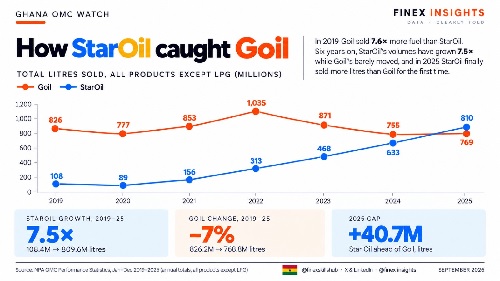
For years, GOIL was the dominant name in Ghana’s downstream petroleum retail market.
It had the largest network, a strong national brand and a commanding lead in fuel volumes. Yet, between 2023 and 2025, that lead narrowed rapidly as StarOil gained market share and eventually moved ahead.
The interesting part of that story is not simply that StarOil sold more fuel. It is how its pricing strategy helped change consumer behaviour in a market where fuel is largely a commodity.
The NPA data shows how the quickly gap closed.
In the first half of 2023, GOIL held about 17.6% of the market, more than double StarOil’s 8.2%. By the first half of 2024, GOIL’s share had fallen to 12.6%, while StarOil had risen to 9.1%. The National Petroleum Authority (NPA) indicated that StarOil gained the most market share among the major marketers during that period.
By the fourth quarter of 2024, the difference had almost disappeared. GOIL accounted for 10.90% of petroleum products sold, while StarOil was at 10.64%. The gap between the two companies had narrowed to just 0.26 percentage points.
Then came the crossover.
In the first quarter of 2025, StarOil recorded 10.80% market share, slightly ahead of GOIL at 10.51%. By the third quarter, StarOil remained ahead at 10.42%, compared with GOIL’s 10.15%. At the end of the fourth quarter, StarOil held 10.63% against GOIL’s 10.01%.
That progression suggests a structural change in Ghana’s fuel retail market.
Price became competitive weapon
StarOil’s management says the company began working on a lower-cost operating model around 2018. According to CEO Philip Tieku, the company focused on reducing supply-chain leakages, using technology to monitor operations and improving efficiencies that could then be reflected in pump prices.
By 2021, management believed it had created enough savings to price fuel materially below some competitors.
That strategy mattered because petroleum products are difficult to differentiate. A litre of petrol sold by one compliant oil marketing company performs essentially the same basic function as a litre sold by another. Location, convenience, trust and service matter, but price remains highly visible to consumers.
StarOil appears to have recognised that.
Rather than compete primarily on premium branding, it positioned price as a reason for motorists to switch stations.
The approach became particularly visible during periods of rising fuel prices. StarOil says it deliberately tried to keep prices relatively low during the sharp increases of 2022. More recently, the company has continued to use aggressive pricing and promotional offers as part of its customer acquisition strategy.
The market-share data suggests that customers responded.
GOIL’s lead did not disappear overnight
It would, however, be too simplistic to conclude that StarOil caught GOIL solely because it sold cheaper fuel.
GOIL itself remained a very large player. The company says it sold more than 1.06 billion litres annually between 2020 and 2022, and its market share reached as high as 22.72% in October 2022.
What changed was the competitive environment.
Ghana’s downstream petroleum market became increasingly fragmented. More indigenous oil marketing companies expanded their station networks, consumers became more sensitive to price differences, and competitors became more aggressive.
The NPA's own concentration measures indicate that Ghana's OMC market is relatively unconcentrated, with a Herfindahl-Hirschman Index of just 465 in H1 2024, far below the 1,500 threshold generally associated with moderate concentration.
In such a market, even a small price difference can influence high-volume customers such as commercial drivers, transport operators and businesses buying large quantities of fuel.
A difference of 20 or 30 pesewas per litre may appear small to an occasional motorist. For a taxi operator, logistics company or commercial fleet buying hundreds or thousands of litres, the savings can become significant.
This is where StarOil’s pricing model appears to have been particularly effective.
Volume became payoff
By 2025, the change was visible not only in market share but also in sales volumes.
Industry data reported by Joy Business indicates that StarOil sold about 818 million litres in 2025, up from roughly 640 million litres in 2024, representing growth of about 27.8%. GOIL recorded about 740 million litres, compared with 768 million litres the previous year.
This is an important part of the strategy.
Lower margins per litre can still produce strong commercial results if lower prices generate enough additional volume. In effect, StarOil appears to have pursued a high-volume model: operate efficiently, price competitively, attract more customers and compensate for thinner margins through scale.
That is a familiar strategy in retail businesses, but it became particularly disruptive in a petroleum market traditionally associated with relatively similar prices across major operators.
GOIL’s response
The competition is far from settled.
GOIL has since acknowledged the changing market environment and identified aggressive pricing by competitors as one of the pressures it faced between 2022 and 2025. The company has responded with its own focus on competitive pricing, station upgrades and operational improvements.
That response shows why StarOil's rise matters beyond the fortunes of two companies.
The broader effect is stronger price competition.
When the market leader is challenged by a competitor willing to operate on thinner margins and higher volumes, incumbents are forced to reconsider their own cost structures and pricing strategies.
For consumers, that can translate into lower pump prices than might otherwise prevail.
The StarOil-GOIL story is therefore less about one company defeating another and more about what happens when pricing becomes a central competitive tool in an increasingly crowded market.
In 2023, GOIL's market share was more than twice StarOil's. By late 2024, they were almost level. In 2025, StarOil moved narrowly ahead.
That is a significant shift in just two years and the data suggests that StarOil's willingness to compete aggressively on price was one of the important forces behind it.