


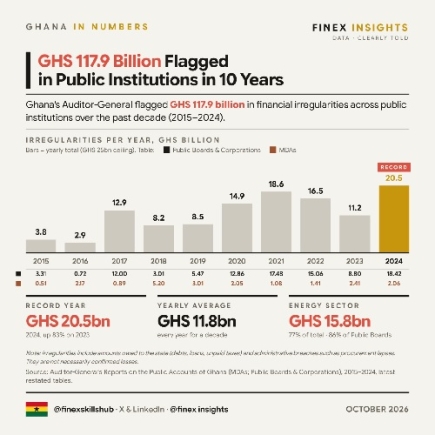
The country recorded financial irregularities totalling about GH¢117.9 billion between 2015 and 2024.
This development highlights persistent weaknesses in financial management and accountability across public institutions.
The amount should not, however, be interpreted as money stolen or permanently lost by the state.
The figure was compiled from the Auditor-General’s annual reports on Ministries, Departments and Agencies (MDAs) and public boards, corporations and other statutory institutions.
It covers a range of issues including outstanding debts, recoverable amounts, procurement breaches, unaccounted transactions and other financial and administrative irregularities.
The 2024 reports showed that public boards, corporations and statutory institutions accounted for about GH¢18.42 billion of the reported irregularities, while MDAs recorded about GH¢2.06 billion.
The combined figure of about GH¢20.5 billion for 2024 was the highest in the 10 years under review and represented an 83 per cent increase over the GH¢11.2 billion recorded in 2023.
The increase was driven largely by public boards, corporations and statutory institutions, whose irregularities more than doubled from about GH¢8.8 billion in 2023.
In contrast, irregularities recorded in MDAs declined from about GH¢2.41 billion to GH¢2.06 billion during the same period.
Energy sector
The energy sector accounted for a substantial share of the 2024 irregularities.
Institutions under the Ministry of Energy recorded about GH¢15.8 billion, representing about 86 per cent of the irregularities reported among public boards, corporations and statutory institutions and about 77 per cent of the combined total for the two audit streams.
The Electricity Company of Ghana (ECG) featured prominently in the findings, with issues including revenue under-declaration, outstanding obligations to other energy-sector institutions, procurement irregularities and weaknesses in financial reporting.
The founder and lead trainer of Finex Skills Hub, Bernard Obeng Boateng, said the nature of the irregularities also varies significantly.
Of the GH¢18.42 billion reported for public boards, corporations and statutory institutions in 2024, about GH¢15.57 billion involved recoverable amounts, including debts, loans and outstanding receivables.
The remaining GH¢2.84 billion comprised administrative and other irregularities.
“The figures, therefore, raise a broader question about the effectiveness of the country’s financial controls and what happens after audit findings are published”, he said.
Stronger enforcement
In an interview with the Graphic Business, a Programmes Officer at the Ghana Anti-Corruption Coalition (GACC), Samuel Harrison-Cudjoe, attributed the recurring irregularities partly to the lack of an effective sanction regime.
He said officials whose actions contributed to irregularities were often not held personally accountable, particularly because audit reports generally identify positions rather than the individuals who occupied them.
According to him, officials could also be transferred from their positions before audit findings were published, leaving their successors to inherit irregularities for which they were not responsible.
He identified weak implementation of public financial management laws, weakened internal audit functions, politicisation of public institutions and inadequate follow-up on audit recommendations as other factors contributing to the problem.
Mr Harrison-Cudjoe said internal audit units were particularly vulnerable because they operated within the institutions they were expected to scrutinise.
He called for greater independence for internal audit functions so that concerns could be raised and addressed before they developed into major irregularities.
He also stressed the need for stronger follow-up after the Auditor-General issued recommendations, including ensuring that recoverable funds were actually paid back.
He said the GACC had established local accountability networks in some districts to track the implementation of audit recommendations and verify evidence of payments and other corrective measures.
According to him, the initiative had contributed to an 84 per cent increase in the implementation of audit recommendations in the districts where the GACC had been working since 2020.
Mr Cudjoe also called for greater use of the Ghana Electronic Procurement System (GHANEPS), saying procurement officers needed regular training to ensure that public procurement was conducted in accordance with the law.
He said the government did not necessarily need to introduce more laws to address the problem, arguing that Ghana already had laws capable of dealing with many of the identified irregularities.
“The enforcement of our laws is our biggest problem,” he said, stressing that sanctions should be applied without fear or favour.
He said stronger enforcement, independent internal audits, regular training and systematic follow-up on audit recommendations would help prevent the recurrence of financial irregularities.