
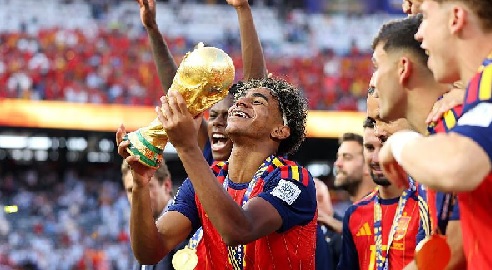
The passing of football's greatest torch could hardly have been scripted more poetically on Sunday, in New Jersey, USA.
On the night Lionel Messi hoped to crown a legendary international career with one final World Cup triumph, it was the teenager widely tipped to inherit his throne who walked away with the sport's biggest prize as Spain defeated Argentina 1-0 after extra time to lift the 2026 FIFA World Cup at the New York/New Jersey (MetLife) Stadium.
Ferran Torres struck the decisive goal in the 107th minute at MetLife Stadium, but this final will be remembered as much for its symbolism as its outcome.
While Messi's glittering World Cup journey appeared to reach its emotional conclusion at the age of 39, 19-year-old Lamine Yamal completed his own arrival on football's biggest stage, helping to lead Spain to a deserved second world title and ushering in what felt like the beginning of a new era.
The Barcelona prodigy did not score, but his pace, invention and relentless attacking threat embodied Spain's superiority throughout a contest in which Luis de la Fuente's side overwhelmed the defending champions from first whistle to last.
After the final whistle, Yamal embraced and consoled the devastated Messi—an image destined to become one of the defining photographs of this World Cup, capturing what felt like the symbolic handover from one generation's greatest player to the next.
Spain's victory was richly deserved. For 107 minutes they dismantled Argentina with suffocating possession, intelligent movement and tactical precision, only to be denied repeatedly by the extraordinary Emiliano Martínez.
Time after time the Argentina goalkeeper produced world-class saves to preserve parity, almost single-handedly keeping the holders alive against a Spanish side that dominated every department except the scoreboard.
Eventually even Martínez could not withstand the relentless pressure.Torres, introduced from the bench by De la Fuente, finally delivered the breakthrough Spain had threatened all evening, rifling home after an incisive move involving Yamal and fellow substitute Nico Williams to spark scenes of jubilation among the Spanish players and supporters.
It was the fitting climax to a tournament in which Spain consistently established themselves as the outstanding team.
Having arrived unbeaten in 37 matches, La Roja once again showcased the qualities that have made them the benchmark of international football—complete control in midfield, relentless pressing and a defensive structure that has been virtually impossible to breach.
Their semi-final victory over France had reinforced their credentials, and against Argentina they produced arguably an even more commanding performance.
Captain Rodri dictated the rhythm with another imperious display at the base of midfield, recycling possession with trademark composure while shielding a defence that barely allowed Argentina a meaningful sight of goal.
Alongside him, Yamal repeatedly stretched Argentina down the right flank, forcing defenders backwards with every touch.
Although he was denied a spectacular late winner by another breathtaking Martínez save from a curling free-kick, the teenager remained Spain's most dangerous attacking outlet throughout the evening.
Argentina, by contrast, never found their usual rhythm. The reigning world champions spent long spells chasing shadows as Spain monopolised possession and territory.
Their feared attack, so prolific throughout the tournament, was largely neutralised by Spain's disciplined defensive shape.
Messi, whose brilliance had carried Argentina to another World Cup final with eight goals and four assists, found himself increasingly isolated.
There were flashes of his genius—an incisive pass here, a clever change of direction there—but Spain's collective organisation denied him the sustained influence that has defined so many of his greatest nights.
The pattern scarcely changed after the interval. De la Fuente increased the pressure by introducing Torres and Williams, whose direct running immediately injected fresh urgency into Spain's attack.
Argentina retreated ever deeper as wave after wave of Spanish pressure crashed towards their penalty area.
Martínez somehow preserved parity, producing another remarkable stop to claw away Yamal's curling free-kick in the closing moments of normal time.
The numbers illustrated Spain's dominance. By the closing stages they had fashioned around 10 clear scoring opportunities, while Argentina struggled to create meaningful openings against Europe's most miserly defence.
Argentina's challenge became even steeper in the 90th minute when Martínez was sent off after receiving his second yellow card, forcing the holders to negotiate extra time with 10 men and without the goalkeeper whose heroics had kept them alive.
The breakthrough finally arrived midway through the first period of extra time.Yamal, once again finding space down the right, delivered an inviting cross that Williams intelligently headed into the path of Torres.
The substitute reacted instinctively, smashing a powerful finish through a crowded penalty area and beyond Argentina's replacement goalkeeper to settle a final that had long seemed destined to belong to Spain.
Even then, Spain continued to threaten.Williams tormented Argentina's tiring defenders, while Torres thought he had doubled the lead before an offside flag denied him.
Argentina threw everyone forward in a desperate finale, winning three late corners, but Spain's disciplined back line calmly extinguished every remaining threat.
