
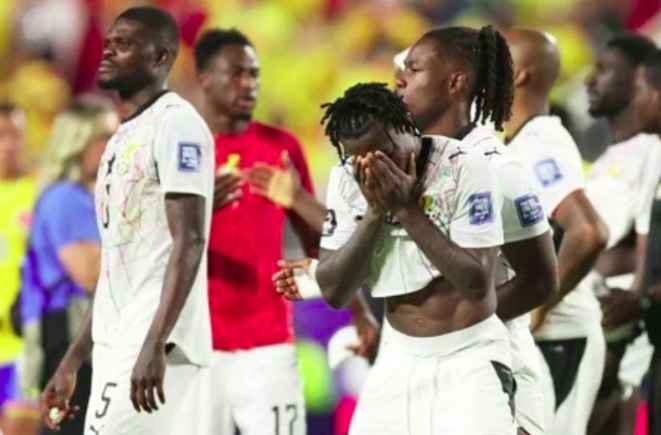
Six days, two defeats, zero points. That is the harsh summary of the Black Stars' opening to the 2027 Africa Cup of Nations qualifiers, and it should end any lingering denial that Ghana football is in trouble.
A 2-0 loss to Côte d'Ivoire in Bouaké could be explained away as a tough away trip against a strong neighbour. A 4-2 home defeat to The Gambia, after leading 2-0, cannot be explained away. Together, the two results confirm what many supporters have felt for years: all is not well with our Black Stars.
The question is no longer whether there is a decline. It is whether those who run our football are willing to accept it, own their part in it, and open the door to a genuine rescue.
Two nights that told the story
In Bouaké on September 24, Côte d'Ivoire controlled the game from the start. Debutant Malick Yalcouyé scored before half-time, and Franck Kessié added a penalty in the 58th minute. Ghana had more of the ball after the break but rarely troubled goalkeeper Yahia Fofana, with the lone striker often isolated.
The Gambia match on September 29 was supposed to be the response. Instead, it became one of the most painful nights in recent memory at the Accra Sports Stadium. Ernest Nuamah's penalty and Felix Afena-Gyan's fine free-kick put Ghana 2-0 up inside 35 minutes. The Scorpions then scored four unanswered goals, the last from Ebrima Colley in stoppage time.
The manner of that collapse matters more than the scoreline. Ghana lost control of midfield, the defence was repeatedly exposed on the counter, and there was no leadership on the pitch to steady the team. The Gambia had never beaten Ghana in four previous meetings. They now sit above us, while the Black Stars are bottom of Group C.
A pattern, not a blip
It would be comforting to call these results a bad week. The record says otherwise.
* Ghana failed to qualify for the 2025 Africa Cup of Nations, a tournament we once treated as a birthright.
* The Black Stars' last win at an AFCON came in 2019, against Guinea-Bissau.
* Our last victory in an AFCON qualifier was against the Central African Republic in September 2023.
* At the 2026 World Cup, a promising start against Panama gave way to a Round of 32 exit to Colombia.
This is a four-time African champion, the first African nation to qualify for the 2010 World Cup, a team that came within a penalty kick of the semi-finals that year. The gap between that history and today's reality is the real measure of the decline.
Injuries and withdrawals are part of the explanation. Mohammed Kudus, Antoine Semenyo, Thomas Partey and Jordan Ayew were among those missing this window.
But strong football nations build depth precisely so that absences do not become catastrophes. The fact that a depleted Ghana side could not hold a two-goal lead at home points to deeper problems of structure, planning and culture.
The leadership question
Football results are made on the pitch, but football cultures are shaped in boardrooms. Kurt Okraku has led the Ghana Football Association since 2019 and was re-elected in 2023. Seven years is long enough for a leader's style and priorities to become visible in the state of the game.
Those years have seen frequent coaching changes, short-term appointments, and recurring questions about player selection, squad harmony and who truly has authority over the national team. The reappointment of Carlos Queiroz for a second spell continues a pattern of chasing quick fixes rather than building a long-term football identity.
The anger after the Gambia match, including boos at the final whistle and calls from commentators and public figures for the President to resign, did not come from nowhere. It is the accumulated frustration of supporters who feel unheard.
This is why the GFA President must engage in honest self-introspection. The questions are uncomfortable but necessary. Has decision-making been too concentrated? Have technical experts been given real independence? Have critics been engaged, or dismissed? Has the focus been on the Black Stars' long-term health, or on managing the next crisis?
Introspection is not an admission of failure. It is what responsible leaders do when the institution they serve is struggling. Whatever the President concludes about his own future, Ghanaians deserve to see that he has asked these questions sincerely.
What a real rescue looks like
The answer is not to disband the team in anger. The answer is broad, honest engagement followed by disciplined action.
1. Accept the truth publicly. The GFA should acknowledge the decline plainly, without excuses about injuries or luck.
2. Convene a national football dialogue. Bring together former Black Stars, coaches, club owners, sports scientists, journalists, supporters' unions and the Sports Ministry. Listen before deciding.
3. Give the technical side real authority. A strong technical director and a coach with a multi-year mandate should shape selection and style, free from administrative interference.
4. Invest in the foundation. Revive youth structures, improve the domestic league and its pitches, and build a clear pathway from the Black Satellites and Starlets to the senior team.
5. Rebuild the dressing-room culture. Players must understand that wearing the shirt is a privilege demanding commitment, fitness and discipline, whatever their club status.
6. Measure and publish progress. Set clear targets and report on them openly, so that accountability becomes routine rather than a reaction to crisis.
The qualifiers are not lost yet. There are four matches left, including two against Somalia and a return meeting with Côte d'Ivoire. But short-term survival must not become another excuse to postpone long-term reform.
The Black Stars belong to all of us
Ghana football has given this nation some of its proudest moments. It united us in 2006, carried a continent's hopes in 2010, and made the Black Star on our flag a symbol recognised around the world.
That legacy is not guaranteed. It must be earned again, and that begins with leaders who are humble enough to look in the mirror. If our administrators accept the truth, engage broadly and act decisively, the stars can shine again. If they do not, Bouaké and Accra will not be the low point. They will be the beginning of something worse.
