
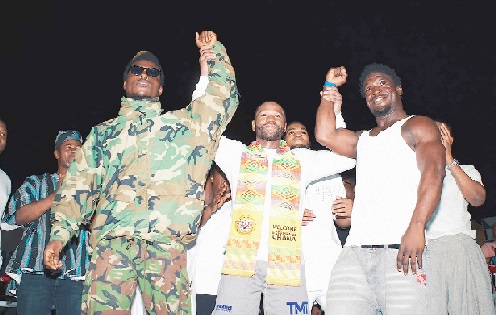
Floyd Mayweather’s visit to Ghana last week and his appearance in Bukom was more than an extraordinary celebrity encounter.
When the undefeated American boxing great stepped into the neighbourhood that has nurtured generations of Ghanaian fighters and world champions, he placed one of Africa’s most storied boxing communities before an international audience.
The applause was deserved. The opportunity it created deserves considerably more attention.
Thousands watched Mayweather display the reflexes, discipline and showmanship that carried him through 50 professional fights without defeat.
At the Bukom Boxing Arena and Bronx Boxing Gym, local fighters encountered an icon whose influence reaches far beyond the ring.
For aspiring boxers who train with limited resources and uncertain prospects, proximity to such a figure can inspire. But inspiration alone cannot finance careers.
The visit, facilitated by Legacy Rise Sports under young promoter, Sharaf Mahama, with businessman Nana Kwame Bediako (Cheddar) playing a prominent role, delivered immediate publicity.
Mayweather met local hero Braimah Kamoko (Bukom Banku), former sparring partner Bastie Samir and promising fighter Theophilus Kpakpo Allotey. Jonathan “Worldwide” Tetteh and “Soja” Elvis Ahorgah gained attention for their December 20 contest when they faced off before him. Ghana’s tourism authorities also recognised Mayweather as an ambassador.
That visibility has value. Yet Ghanaian boxing must demand something more durable than photographs, social-media impressions and warm declarations.
Legacy Rise has acknowledged discussions about future collaboration, potentially including a major boxing event. No formal partnership or investment has been confirmed. This is precisely why the next phase matters more than the spectacle itself.
Sharaf Mahama and his team should convert access into a structured commercial proposition: an international fight card featuring Ghanaian talent, matchmaking relationships with established promoters, broadcast distribution and sponsorship packages that can support repeat events rather than a single glamorous night.
The ambition should be to take Ghanaian fighters into larger markets while making Accra an attractive destination for credible promotions.
Within the next three months, promoters should publicly publish a realistic partnership roadmap, identify a shortlist of market-ready fighters and establish who will fund the proposed activities. Promises should have owners, deadlines and measurable outcomes.
The Ghana Boxing Authority, gym owners, managers, corporate sponsors and public institutions also have responsibilities.
Ghana needs transparent purse arrangements, dependable medical protection, properly equipped training facilities, coaching exchanges and professional career management.
Without these foundations, international attention will benefit intermediaries more than the athletes who generate the spectacle.
There is another lesson. Former world champion Joshua Clottey complained about his exclusion, while several celebrated predecessors were absent. Such omissions weaken the chance to present Ghana’s boxing heritage as a collective national asset.
Former world champions Azumah Nelson, Ike Quartey, David Kotei (D.K. Poison), Nana Yaw Konadu, Joseph Agbeko and Clottey should be partners in talent development and international engagement, not incidental guests whose inclusion depends on personal connections.
This newspaper welcomes the exposure Bukom received. But the appropriate measure of success is not the size of Mayweather’s audience.
It is whether, six or twelve months from now, Ghanaian boxers have secured better-paid fights, meaningful mentorship, stronger promotional backing and a clearer route to sustainable careers.
Mayweather brought the spotlight. Ghana’s boxing leadership must now build the stage that remains after he has gone.
