
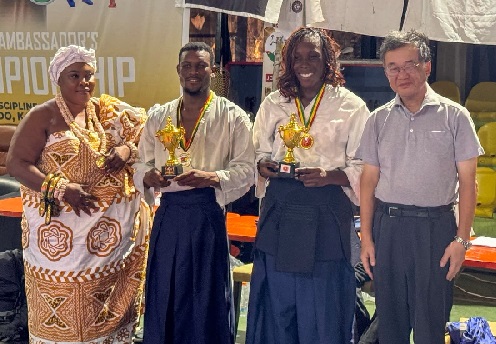
Interest in martial arts has seen a steady increase among children and young people in Ghana, with the four federations responsible for the sports reporting growing participation and efforts to expand their respective disciplines.
The growing interest in Judo, Karate, Kendo and Jiu-jitsu — has been reflected in increased enrolment of young practitioners, with parents also increasingly seeking training opportunities for their children in the various disciplines.
However, the federations have identified inadequate funding, limited international exposure and the need to create economic opportunities for practitioners as major challenges to sustaining the growth and developing athletes for higher-level competitions.
Competition
They made the remarks at the 2026 Japanese Ambassador’s Championship in Accra.
It featured competitions in judo, karate, jiu-jitsu and kendo, with participants battling for honours in various male and female age categories.
The contests produced gold, silver and bronze medallists across the four disciplines following the respective bouts.
Beyond the medals awarded to the top performers, all competitors were presented with certificates of participation for taking part in the championship.
More interest
The President of the Ghana Kendo Federation, Sesinam Don Dzakpasu, said the sport had attracted more than 120 practitioners despite being officially introduced in Ghana less than two years ago.
“There’s a lot of interest every now and then,” he said. He attributed the growth to grassroots recruitment and expansion efforts, with parents increasingly seeking training opportunities for their children.
The President of the Ghana Judo Federation, Samuel Kenneth Arthur, said the championship was being used to rebuild the national team ahead of the Olympic qualification process.
The federation intends to identify seven top athletes for further preparation. “We use the competition to get first to the national team,” he said, adding that funding would be needed for the qualifying competitions.
Funding, marketability
The President of the Ghana Karate Federation, Nathaniel Johnson, decried inadequate funding and logistical support, which he said denied athletes opportunities to gain international exposure.
He stressed that sustained championships were important for building practitioners’ confidence and providing opportunities to develop their abilities, while international training opportunities could further motivate young athletes to remain committed to the sport.
“We don’t get an opportunity to explore outside,” he said, calling for more support.
A Professor of Jiu-jitsu, Khalid Davis, said creating viable economic opportunities around martial arts was necessary to encourage practitioners to invest seriously in developing their abilities.
He said athletes needed to see a pathway through which the skills they acquired could eventually provide livelihoods.
“After we invest to learn, how can I eat and how can I earn a living?” he said.
Prof. Davis noted that professional opportunities in jiu-jitsu were expanding internationally and said Ghana needed to position its athletes to benefit. He advocated more tournaments to improve the quality and depth of practitioners available for international opportunities.
Optimism
The Japanese Ambassador to Ghana, Hiroshi Yoshimoto, expressed optimism about the growing interest of children and young people in martial arts in Ghana.
He said participation in the annual Japanese Ambassador’s Championship had continued to improve, providing an encouraging indication of the potential for developing the disciplines from the grassroots to the international level.
“I commend the number of children players and performers increasing recently. There is hope for us that the federation will be improving and going forward,” he said.
He expressed the hope that some of the emerging young athletes would eventually progress to competitions on the African continent and potentially the Olympic stage.
The Ambassador said participation in martial arts also offered benefits beyond competitive success by teaching practitioners respect, perseverance, self-control, humility and resilience.
He said those values were important in everyday life and could help young practitioners develop character while strengthening friendships and mutual understanding.
Ambassador Yoshimoto added that the championship had continued to flourish year after year and encouraged participants to measure success not only by winning, but also by their courage to compete, discipline to improve and respect for opponents.
