
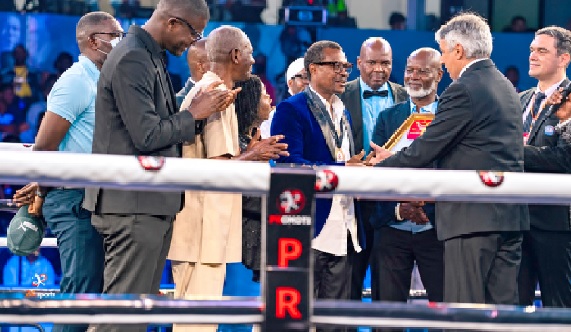
Nearly three decades after Ike “Bazooka” Quartey ruled the WBA welterweight division, the World Boxing Association has formally celebrated one of Ghana’s most accomplished fighters, honouring him for a career that helped push African boxing onto the sport’s biggest stages.
Quartey received a special citation and medal from the WBA, in partnership with promoters Obra Sports, during the Osagyefo Fight Night at the Bukom Boxing Arena last Saturday.
The recognition celebrated not only his achievements as a former WBA welterweight champion, but also the lasting influence of a fighter whose power, discipline and uncompromising style made him one of Ghana’s most formidable boxing exports.
The citation described Quartey as a Ghanaian boxing legend and pioneer, highlighting his historic championship reign and contribution to the growth and legacy of the sport in Ghana.
It also praised his courage, discipline and excellence, presenting his career as an inspiration to successive generations of Ghanaian fighters.
The WBA Supervisor Hernan Ramiro Salvo, who presented the honour, said Quartey’s impact extended well beyond the titles he won.
“From the WBA president, thanks for what you have done for our sport and on behalf of your country. Thank you,” Salvo said.
He stressed that recognising former champions such as Quartey was important because of the standards they established for younger fighters.
“This award is for the career and example he has set around the world. It’s really important to recognise these kinds of people,” Salvo added.
“He’s a big example for youth around the world and Ghanaian boxers.”
For Quartey, the moment also offered an opportunity to reflect on his place in African boxing history.
Visibly delighted by the honour, the former world champion said, “I’m very happy because I was the first African boxer to go beyond the featherweight. That’s Ike Bazooka Quartey.”
Whatever the passage of time, Quartey’s championship résumé remains formidable.
He captured the WBA welterweight title in June 1994 when he stopped Crisanto España in France, launching a dominant four-year reign at 147 pounds.
Quartey successfully defended the title seven times and never lost the championship in the ring. The WBA eventually stripped him of the belt in 1998 because of inactivity.
His combination of a piston-like jab, physical strength and knockout power made him a major force during one of boxing’s strongest welterweight eras.
Quartey’s international profile grew further in February 1999 when he challenged American superstar Oscar De La Hoya for the WBC welterweight championship in one of the most memorable fights of his career.
He ultimately retired in 2006 with an imposing professional record of 37 victories, four defeats and one draw, with 32 of those wins coming by knockout.
But his pedigree had been established long before he entered the professional ranks.
As an amateur, Quartey compiled an outstanding 50-4 record, won bronze at the 1987 Junior World Championships and represented Ghana at the 1988 Olympic Games in Seoul.
That progression — from elite amateur prospect to world champion — placed him firmly in the tradition of Ghana’s internationally respected fighters and helped sustain the country’s reputation as one of Africa’s most important boxing nations.
The timing of the WBA recognition also carries wider significance for Ghana boxing.
At a period when the sport is searching for its next sustained generation of world champions, Quartey’s career provides a reminder of the level of preparation, ambition and international competition required to reach the summit.
Ghana has produced celebrated champions across different eras, but Quartey’s four-year reign remains a benchmark: seven successful title defences, a world championship he never surrendered in the ring and contests against some of the biggest names of his generation.
The WBA honour at Bukom was, therefore, more than a nostalgic tribute to a retired champion.
