
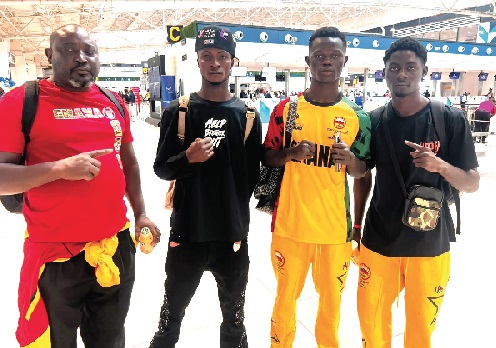
Ghana will field just three boxers and no women at the IBA Africa Elite Championships in Kinshasa after a government funding shortfall wrecked plans for two major continental tournaments, exposing the fragile support system behind one of the country’s most successful sports.
Commonwealth Games medallists Amadu Mohammed and Joseph “Jaguar” Commey, alongside Ebenezer Ankrah, have travelled to the Democratic Republic of Congo for the October 19–November 1 championships — a skeletal contingent for a nation with Ghana’s boxing pedigree.
The trio departed Accra yesterday with Coach Charles Quartey, their participation offering little consolation after Ghana’s proposed involvement in the World Boxing African Championships in Nairobi, Kenya, running from October 15 to October 28, also fell victim to the funding squeeze.
Mohammed won bronze at the 2026 Commonwealth Games in Glasgow and is an African Games champion, while Commey claimed silver at the 2022 Commonwealth Games and gold at the African Games.
Ankrah, another member of Ghana’s Glasgow 2026 squad, represents the next generation hoping to establish itself internationally.
Their pedigree offers Ghana genuine medal prospects, but the scale of the withdrawal tells a more troubling story.
The country will contest just three of the 13 men’s divisions in Kinshasa, leaving 10 unrepresented, while no Ghanaian woman will compete across the tournament’s 12 female weight categories.
For Ghana Boxing Federation (GBF) President Dauda Fuseini, it is a damaging setback at a time when the national team needs regular international competition to build towards the Los Angeles 2028 Olympic Games.
“It is very sad the way the government has refused to support boxing,” Fuseini told the Graphic Sports, arguing that the missed opportunities represented a disservice to athletes who had trained for international competition but were now staying home.
“Boxing is a very difficult sport and you cannot keep training without fighting. Lack of support will discourage the athletes left behind,” he warned.
That frustration is shared by former world champion Joshua Clottey, who rose through the amateur ranks and represented Ghana internationally before establishing himself in professional boxing.
“Amateur boxers are under the care of the government. The government is supposed to take care of them. We are not talking about professional boxing,” Clottey lamented.
He questioned the imbalance between the resources devoted to large football delegations and the limited backing for boxing, accusing successive governments of failing to match the sport’s record of international achievement with sustained investment.
The financial consequences could extend beyond missed medals. Prize figures cited for the Kinshasa championships put gold at $20,000, silver at $10,000 and bronze at $5,000 in each of the 25 weight categories, although organisers have yet to publicly confirm the final amounts.
The competition also provides exposure ahead of the inaugural IBA President’s Cup in Istanbul, scheduled from November 25 to December 5.
The event carries a $3 million prize fund, with individual champions set to receive $100,000, as well as opportunities to earn IBA ranking points.
