
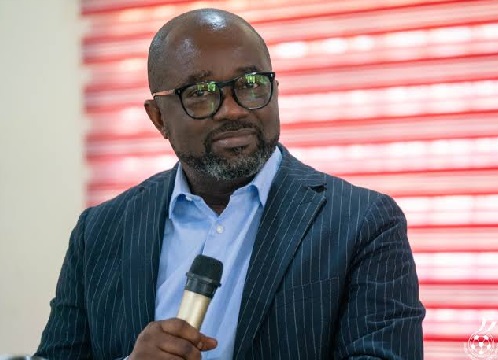
Ghana Football Association (GFA) President Kurt Edwin Simeon-Okraku and members of the Association’s Executive Council on Wednesday, November 4, 2026, appeared before Parliament’s Select Committee on Youth and Sports to discuss the state of football in Ghana and measures needed to strengthen the domestic game.
The discussions covered the Black Stars’ prolonged Africa Cup of Nations (AFCON) trophy drought, challenges confronting the national teams, inadequate logistics, sponsorship restrictions, taxation, infrastructure, refereeing and investment in football development.
Below are the major issues raised by the GFA President and the key excerpts from the engagement.
1. Removal of restrictions on alcohol sponsorship
One of the major issues raised by Mr Simeon-Okraku was the restriction on alcoholic beverage companies sponsoring sporting activities, which he said had deprived Ghanaian football of significant commercial opportunities.
He disclosed that the GFA had lost a potential sponsorship agreement worth more than US$5 million annually with Guinness Ghana Limited after the Food and Drugs Authority (FDA) declined to approve the proposed partnership.
According to him, the beverage company had approached the Association with plans to invest substantially in the Ghana Premier League, but the deal collapsed despite several engagements.
He appealed to Parliament to lead efforts to remove the regulatory provision allowing the FDA to approve or reject sponsorship agreements involving alcoholic beverage companies.
"We were approached by Guinness Ghana Limited wanting to invest heavily in the Ghana Premier League. We did whatever we had to do. We had a series of meetings. At the end, FDA said no. The deal was, if I'm not mistaken, over $5 million a year. We lost it," he said.
He added: "If there's one thing that you can do to help sports and football, that would be for you to lead the charge to completely take out that provision."
2. 20 national teams share one broken bus
Mr Okraku also highlighted the logistical difficulties facing the country's national teams, revealing that all 20 national football teams had been relying on a single bus purchased by the GFA in 2008.
He said the vehicle, which served the Black Stars, Black Queens and 18 other national teams, had broken down, forcing the Association to hire buses during the most recent international football window.
He described the situation as one of the fundamental challenges that must be addressed to build a sustainable football development system.
"Your Black Stars, your Black Queens, and 18 other national teams that we do have, have access to one bus that was purchased by the FA in the year 2008. Twenty national teams using one bus. Now the bus is broken, so during the last international window, the FA had to rent a bus."
He stressed that adequate logistical support was essential to the consistent preparation and performance of the national teams.
3. Tax exemptions on national team equipment
The GFA President appealed for tax exemptions on equipment and playing kits imported for the national teams, saying import duties sometimes created financial difficulties for the Association.
He explained that the GFA occasionally struggled to clear playing kits supplied through its technical partnership with Puma because of the associated import charges.
He recalled an incident before Ghana's match against South Africa in Cape Coast when the Association had to arrange the clearance of 30 pieces of playing equipment to enable the Black Stars to use their uniforms.
"On every given occasion, we have to go to the port, import duties. Sometimes, the FA is handicapped. We don't have the finances," he said.
He also questioned the 17.5 per cent Value Added Tax (VAT) charged on football match tickets, arguing that the tax burden on football should be reviewed in comparison with other entertainment activities.
"We are charged 17.5 VAT at the gate on every game that we play. And yet, other entertainment providers are charged less."
4. Call for private discussion on Ghana’s 44-year AFCON drought
Mr Simeon-Okraku acknowledged Ghana's prolonged inability to win the Africa Cup of Nations since 1982, despite having produced several generations of talented footballers.
He stated that the Black Stars had reached three AFCON finals during the 44-year period but failed to secure another continental title.
However, he indicated that there were underlying issues contributing to the drought which he was unwilling to discuss in an open parliamentary sitting.
He therefore requested an in-camera engagement with the Committee to discuss the factors behind Ghana's inability to reclaim the continental trophy.
"There are certain reasons that I will not want to talk about here because I see cameras and whatever we say here is public. Sometimes certain truths said at the wrong time could be very damaging."
He added that the Committee could engage the Association privately if it wanted to understand the underlying reasons for the country's prolonged wait for another AFCON title.
5. Investment in grassroots football and infrastructure
The GFA President stressed that sustained success in football required more than the performance of national teams at international competitions.
He called for continuous investment in grassroots and youth football, coach education, scouting systems, quality playing pitches and modern stadium facilities.
He also advocated greater exposure for Ghanaian coaches to international football environments to improve their technical knowledge and development.
According to him, the absence of these structures had affected the country's ability to maintain consistent success across generations.
"This includes but not limited to continuous investment in grassroots football, Colts football, coach education, exposing your coaches to the international market, good scouting, good facilities, i.e. football pitches for the kids to play, for the senior team players to play, and good stadium facilities," he stressed.
He maintained that football development required collective responsibility and sustained investment beyond the mandate and resources of the GFA.
6. Independent private entity
Mr Simeon-Okraku also reminded the Committee that the GFA was an independent private entity rather than a government institution, although it worked closely with the government on football development.
He expressed surprise at Parliament's invitation for the Association to explain its business relationship with a private entity promoting the Ghana Premier League.
He maintained that the GFA had the responsibility to establish commercial partnerships to support football development.
"The GFA is a private entity. It is not a government organisation. The GFA works closely with government and that has been the practice throughout," he stated.
He nevertheless indicated the Association's willingness to engage Parliament on issues affecting the development of the sport.
7. Other major issues
The wider engagement also covered:
- Black Stars' performance: The Committee discussed the national team's performance and the challenges affecting Ghanaian football.
- Domestic football: The development and commercial sustainability of the Ghana Premier League featured prominently.
- Refereeing: Issues concerning officiating and the general administration of football were also raised.
- Financial constraints: The GFA highlighted the difficulties associated with funding national teams and running football development programmes.
- Infrastructure: The need for improved playing pitches, training facilities and stadiums was emphasised.
