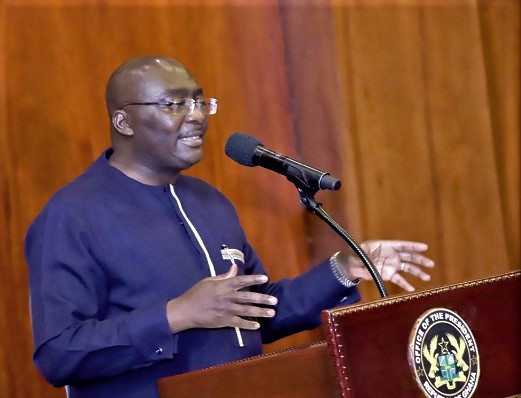
The flagbearer of the New Patriotic Party (NPP), Dr Mahamudu Bawumia, has called for a decisive shift in national policy to protect local rice producers from rising production costs at home and the falling prices of imported rice.
He stated that the biggest challenge facing the sector was imports, which he indicated were too high.
Dr Bawumia made these remarks when he interacted with farmers at Asutuare in the Eastern Region last Friday, November 13, 2026, noting that the price of imported rice was lower than that of local production.
The Japan example
Citing the Japanese situation to buttress his point, Dr Bawumia said rice in Japan is treated as a matter of national security, and Ghana needed to adopt a similar approach to protect its farmers.
"Rice prices in Japan are almost 50 per cent higher than the world price. We import over 50 per cent of rice. In Japan, it is less than 10 per cent," he stated, adding that the comparison exposed Ghana's attitude problem towards agriculture.
While Japan deliberately protects its farmers, the NPP Flagbearer and former Vice-President said Ghana has left its rice sector exposed to imports that undercut local farmers. He called for an attitudinal change towards agriculture and rice farmers, stressing that "We need to protect our rice farmers in Ghana."
"The imports are too high. The price of the imports is lower than the price of the local production," he said.
A major driver of this disparity, he explained, was the exchange rate. He noted that the cedi's appreciation had reduced import costs by about 40 per cent in the last two years.
"The exchange rate has fallen by 40%. The import cost has come down by 40 per cent. You are hurting the farmers," he added, noting that at the same time, the cost of production for local farmers had gone up.
The production paradox
The result, Dr Bawumia said, is a paradox in which farmers are producing more and more rice but cannot sell it. He noted that the market was flooded with cheaper imports, creating excess capacity and leaving farmers with unsold stock.
"You are producing more and more rice. That is why you have excess capacity. The whole Ghana rice farmers, because imports are performing, because the price of those imported bags of rice are performing," he said.
Supporting local rice
To reverse the trend, the NPP Flagbearer called for a strong strategy and policy framework to protect rice farmers and agriculture as a whole. First, he said, the government must lead by buying local.
"As a nation, as a government, we need to buy more local rice for our schools and our prisons. Everywhere, we need to buy more local rice. We need to empower buffer stock to buy more local rice because if you do not, you will create unemployment. It is very, very important," he pointed out.
Furthermore, Dr Bawumia said, "Ghana must deliberately reduce rice imports because we believe that Ghana can be self-sufficient in rice production." He noted that the country has both the potential and the land to produce enough rice.
Central to that self-sufficiency drive, he said, was the availability of water. He, therefore, called for the urgent completion of Phase Two of the Pwalugu Irrigation Project, which has stalled for the last two years.
"We should finish the Phase two of the Pwalugu Irrigation Project so that you can have the water to do the production. The last two years, there has been no work," he said. "And also, some of the various lots, no production for the last two years. Farmers are at home. We need to finish the Phase two."
Dr Bawumia also called for the return of the fertilizer subsidy for farmers to help bring down production costs. Underpinning all these proposals, he said, was a single principle: the nation is vulnerable if it cannot feed itself. He stated that his government would treat agriculture as a matter of national security, adding that when it comes to food, the country should depend on itself.
Farmers' plight
Sharing their concerns, the rice farmers said they were suffering because they had produced rice for two years but could not sell it.
"We produce rice and it is our expectation that we are able to sell so that we can make money and look after our children, but unfortunately last year and this year we could not sell the rice," said a farmer and Secretary of the Northern Low Level Branch of the Water Users Association, Alex Tawiah Amano.
He acknowledged that the problem was nationwide but noted that through their network of irrigation schemes, farmers reported the same situation at Asutsuare, Akuse, Kpong and elsewhere. He said buyers were not forthcoming, noting that rice must move in tonnages to empty warehouses.
Another rice farmer with over three decades of experience and leader of the Shai-Osudoku Rice Farmers, Sika Bright, who said he represented over 3,500 farmers, noted that thousands of tonnes were packed in mills, with weevils destroying them.
"For me alone, it is over 100 tonnes. Farmers have to take loans from banks to do this farm, and at the end of the day, the rice will be there and it will spoil," he said.
A branch chairman with 192 farmers said his 192 hectares have not been cropped since rehabilitation began, and contractors had left the site. He appealed to the government to intervene to create a market for local rice.